
Article
Starts with a Stitch
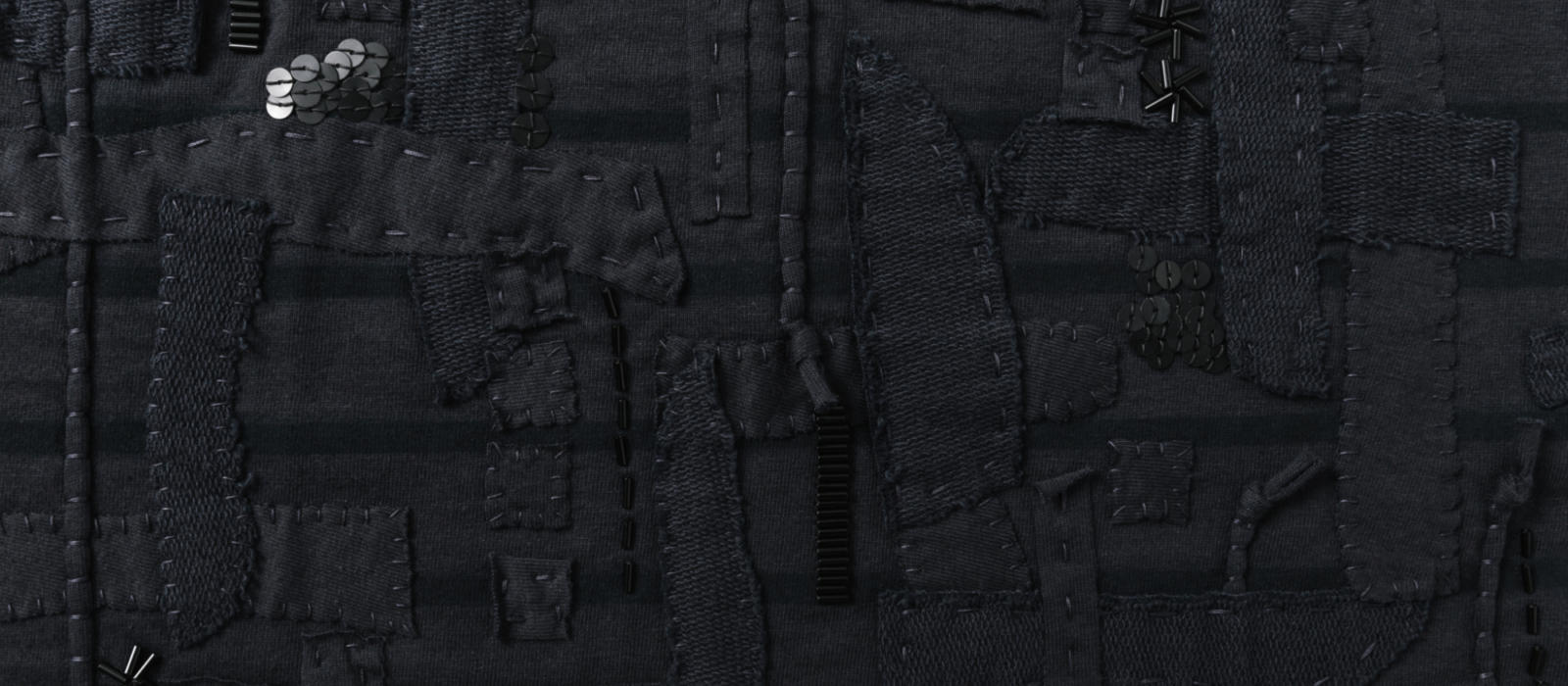
2020 marked 20 years of sustainable design for Natalie Chanin. Beginning with hand-sewing garments from cotton T-shirts, she evolved her company into the beloved fashion brand Alabama Chanin. Now with The School of Making, The Factory and Bldg.14, Natalie is continuing her outreach to share her love of well-designed, thoughtfully made, locally sewn goods.
What drew you to design and textiles as a lifelong pursuit?
Natalie Chanin: I recently heard Brother David Steindl-Rast, a beloved Benedictine monk, in conversation with Krista Tippett, say:
“…most people don’t think of it, but in the end, we always eat earth. We eat earth, not in an abstract way; in a very concrete way, this humus is what we eat. Or crystals: when we eat salt, it’s pretty obvious that comes out of the earth. That’s earth, directly. When we eat vegetables, well, the vegetables were nourished by all the nutrients in the Earth, and then now we eat them, or the fruits of these plants. If you eat meat or fish, then they were nourished by vegetables, and they were nourished by the earth. Always comes back to earth.”
When I heard that, I felt such a sense of beauty wash over me, because I’ve always felt the same way about fibers, fabric and, by extension, clothing and embroidery. They are of the earth. And I’ve always connected this “idea of earth” to my home plot, the red dirt of my childhood in northwest Alabama. Separating one’s work from an origin story can be a difficult task – at least that is the case with me. My region, my origin story, is such a deep part of the work. I would go so far to say that my work and life, and work-life, have always radiated out from this place – this earth.
Sewing, embroidery and the acts of making and providing are so tied to all of my childhood memories: my grandparents’ farms, piles of vegetables, the ever-present sewing machines, meals, the cotton, the boisterous noise of girls discussing next outfits to be curated or made. It felt like a process of drawing from the earth and making whole. It was such a simple understanding that all things – houses, barns, bread, clothes – could be made by the hands of someone I loved – and someone who loved me.
I suppose it was this deep sense of capacity that drew me to my lifelong pursuit of making textiles and clothing. Seeing my grandmother imagine a pair of pants and then simply “make them up” had a deep impact on my own imagination. Her ability to alter a dress by shortening the hemline and using that cut off fabric to make a belt felt like magic when I was a small child. To me, these women were like magicians who had control of the entire material world. It never occurred to me that not all humans made this kind of magic every day. In the end, I was lucky that my grandmothers kept all of their favorite designs – material culture, their material memories you might say – stored in attic closets and out-of-the-way spots. Prom dresses and woolen suits were my everyday playground, each one a story that could be acted out in my hungry mind.
I was so surprised to learn when I grew older that there was a word to describe this capacity to imagine and make: design. I was even more surprised to learn that you could train this capacity for imagination and that design could be a career choice.
After living in other places, what led you back to Florence to make a home for your company?
After 22 years of making my way in the world with my family, I was living and working in New York City. I’d begun a small project of sewing hand-stitched T-shirts and was looking for a manufacturer to sew a simple stitch – akin to a hand-quilting stitch. This search proved impossible, and in a moment of clarity, I understood that I was looking not for an embroidery manufacturer but for the quilters of my childhood. I envisioned a project of coming home to work with these quilters, building on their capacity and talent, while also making a short film about old-time quilting circles. The idea was to present the documentary film and T-shirt collection as a one-time project before going back to my “other life.” What I didn’t realize was that while I thought I had been radiating further and further away from Florence, unbeknownst to me, all along I had just been circling my way back to this community of my childhood.
What does community mean to you?
Community is such a simple and beautiful and complex and fraught word. Of course, there is the biological community of organisms living together in physical proximity. And, there is also our innate understanding of community: A group of diverse people who are linked by beliefs, social ties, common perspectives and goals. Neither of these definitions feel enough for me as we navigate the current cultural climate. For me, community is about belonging and feeling safe; however, this is still not enough. I think a lot about the term “Beloved Community,” coined by philosopher Josiah Royce and envisioned by Dr. Martin Luther King, Jr. as “a society based on justice, equal opportunity, and love of one's fellow human beings.”
I want to believe in, and work towards, a community that gives us all a sense of place and belonging but also stretches us to move “beyond ourselves,” as Dan Rather wrote in his book What Unites Us. I want community to be a noun and a verb simultaneously, the meaning constantly flowing between service, stewardship, shared responsibility, respect and joy – radiating in ever-widening circles. This expanded idea of community as service allows my most intimate community to be an integral part of the greater whole.
What do you hope your work and your establishment are sending out into the community?
Part of the Alabama Chanin mission statement reads, “In passionate pursuit to design, responsibly produce, and sell products and experiences that enrich life, community, and planet.”
I hope that this commitment – to people, to cultural, ecological and fiscal sustainability, channeled through design principles – is unmistakable in the work Alabama Chanin is putting out into the world. The Alabama Chanin visual symbol – or mark – is an “A” that is created by a series of arms that radiate out from a central point, which is then partially encircled with a “C.” This “AC” mark was designed, by our friends at Commune Design in Los Angeles, to commemorate our 10-year anniversary.
Looking back, it’s miraculous how the symbol perfectly reflects our tenets and how the organization has evolved in these following 10 years. The mark was a beautiful foreshadowing to the growing arms of our business and how they would intertwine while reaching outward into the world.
We’ve now spent 20 years designing, selling and manufacturing the most beautiful and functional organic cotton garments through Alabama Chanin – with an unbroken regional supply chain for the majority of our products. We’ve worked to develop new and sustainable practices in community manufacturing with the making arm of the business, called Building 14. We’ve also taught our method of sewing and manufacturing to people around the globe through The School of Making, in order to share and preserve this craft in our lives and future. We began hosting events, dinners, symposia and an expanded series of workshops through The School of Making. Pre-Covid, we gave studio and manufacturing tours every weekday. Some days there would be 20-plus people wanting to view for themselves what manufacturing in America looks like today. Perhaps the most surprising thing is that some things have not changed much.
Additionally, in 2013, we opened a flagship store, a café and machine manufacturing facilities at The Factory. The Factory is a simple place, a 1980s-era metal building, in the middle of the Florence Industrial Park. We inhabit a liminal place between city and county, town and country. There is industry beside what used to be cotton fields, and, before that, hunting grounds of the Native Americans who settled this place long before a garment like a T-shirt was imagined. There are still vestiges of that wild hunting ground. A few years ago, my son, a chef, while taking a break from the café, watched a bobcat amble from the young-growth woody brush on a neighboring lot. This beautiful, wild creature looked around, walked past him and went back into the undergrowth as my son sat perfectly still.
In a sense, this is where we live and work. The liminal space between imagination and capacity, history and future, imagined design and cotton fibers, modernity and the wild.
Where do you draw inspiration from for patterns or designs?
Despite urbanization and deforestation, there is still a wild that thrives so close to our city – and in so many parts of our nation and this world, although that is declining. This region is of a climate where Mother Nature can devour an unattended structure in a matter of months. Between decay, kudzu, fast growing plants and a tornado or two, this same unattended structure can be rendered invisible to the untrained eye within a few years. Visitors from afar marvel at the alarmingly loud sounds of nature – the whirr of insects on a Summer night. I often don’t register the sound; for me, here, it is just a part of life. But it is a joy to be reminded of the loudness of my place, and I never, ever forget the deep inspiration that comes from living so close to the land, the wild. As so many creative minds, I have always been inspired by this wild, and nature, and sense of place. I love the idea that a photographer may take a picture of a tree which then becomes a writer’s inspiration for a short story, which in turn inspires an architect to design the entrance to a building inspired by the idea of a tree. And so, by the logical extension of this idea, I’m even more inspired by all the things which were inspired by the wild, and nature, and sense of place. This long list includes but isn’t limited to: architecture, geometry, botany, photography, color theory, physics, gardening, theology, philosophy, painting, poetry, prose and fiction.
When I was a child, there was a joke in my family that I got excited when the sun rose, and it was true. There are stories of toddler me leaving the house before sun-up to explore the neighborhood as my family slept – and being found at unsightly hours of the morning washing the car, collecting acorns or talking to birds. Then there are the stories of me as an older child, climbing to the very top of a tree, so high that the trunk would bend under my weight – always pushing to the very edge of what was possible as my grandmother willed me down safely. I remember trying to talk to the birds and hoping beyond hope that they would talk back. As I approach 60, I feel exactly the same way and still get excited when the sun rises. I lie in bed each morning and conjure a (too long) list of what I will get to explore and examine on this day. There is still so much inspiration to be found, and I still delight in the finding.
Describe how you approach a textile pattern, creating a pattern that radiates from a starting point. How do you tease this idea into a pattern that comes to life?
I was once taught that there are three distinctive ways we can examine a thing, a thought or a pattern: wide-angle, medium-range and close-up. This very wise teacher stressed that the best designs incorporate all three: something to delight from afar, this is what initially draws you in; something to intrigue as you approach, this is what captures you; and something to make you want to touch it when you arrive up close, this is what keeps you.
When designing a pattern, I try to keep these ideas at arm’s reach: delight, intrigue, captivation. This has been my process for almost four decades. I start with the micro view. A pattern in its smallest part is simply a collection of small motifs, or shapes. Once a motif or a collection of motifs have been developed, you can then play with how scale, repetition and color interact at all the different ranges – working from the close-up, microcosm view outward to the wide-angle, forest view. There is such a beautiful, symbiotic relationship between all the parts of this process, from inspiration to embroidery.
I also do not do it alone. Today, we have a wonderfully talented team that facilitates every step of this work, and I’m grateful to have the opportunity to work with these immensely gifted men and women.
How does it feel to be celebrating 20 years of sustainable design?
Honestly, it feels like one year since I first returned home to begin this work. Celebrating 20 years feels surreal. I’d been talking about the 20-year celebration for some time, but still, I have to admit that it snuck up on me – and then it arrived in the middle of a global pandemic. So many plans I’d imagined changed. But now that I’m here, it seems even more exciting to begin planning for the next 20 years of sustainable design. I guess the lesson here is to learn to live in, and celebrate, today. Today, I am delighted and deeply grateful that I’ve been given 20 years to do this work. Tomorrow, I’m looking forward to how we empower the next generation to move this work to the next level.
Your company and your process tie you to the past – of the South, of the community, of your family. What do you want to teach or give to future generations with your work?
Those of us working with cotton in the South have a responsibility to look at our past, through the lens of the present, with an eye to the future. We can’t change what has happened, but by actively seeking to understand our past in all its horror and beauty, I believe we can begin to build that Beloved Community together. The same is true of the environment and working in sustainability; by looking to the past and seeking to understand the wisdom of how previous generations lived in harmony with land and water, we can create stories – and material cultures – that are a part of future solutions.
Together we can stand, 20 years in, feet firmly in the present, with an eye to the past and our hands working together towards the future.