
Article
In His Element
photos by Shawn Poynter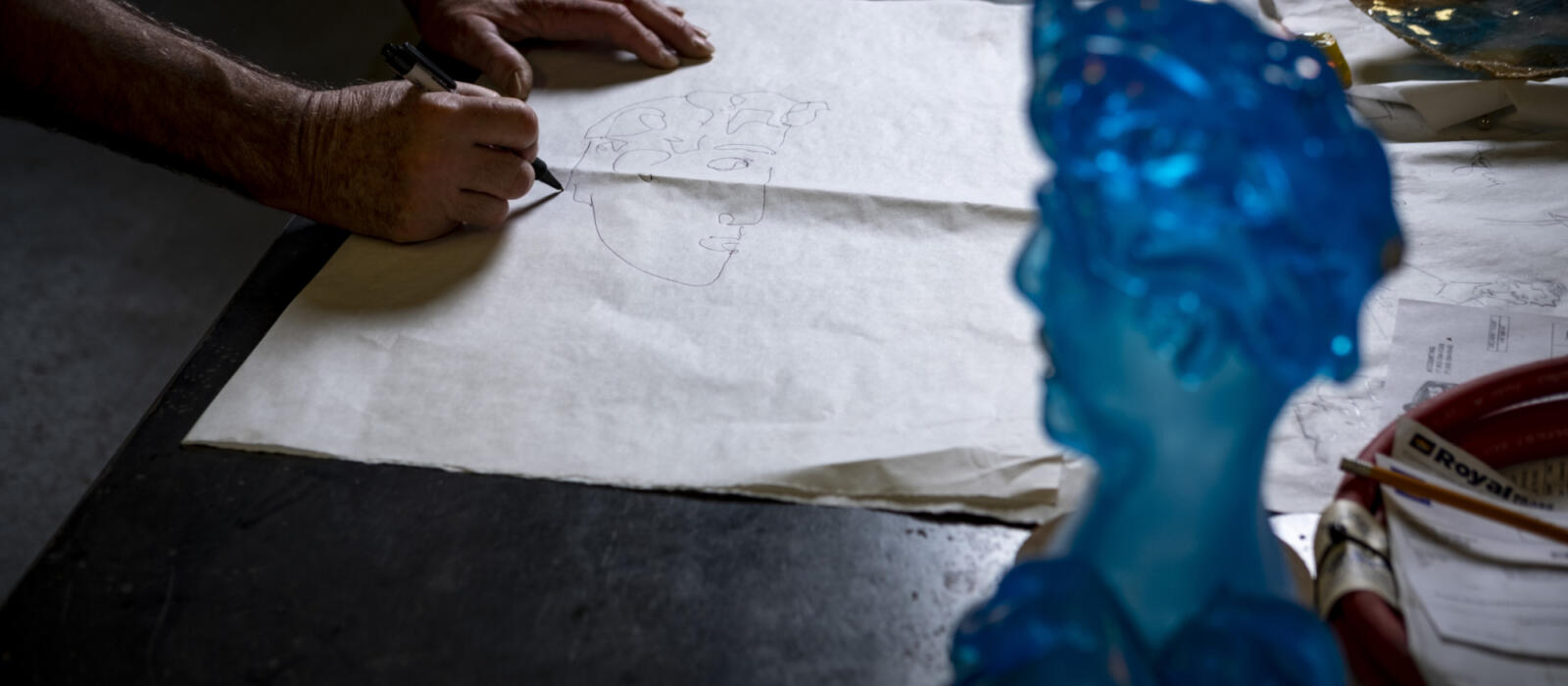
Richard Jolley’s studio is tucked into an unexpected bend off a busy road in Knoxville, Tennessee. He’s let the foliage grow freely, creating a natural barrier that helps you quickly forget how close the rest of the world is. The quiet, unassuming look of the exterior is a charming juxtaposition to the vibrancy of the art being created within.
Richard’s studio is filled with in-progress pieces, collection boxes of broken glass and an impressive array of tools. “I think all artists are hoarders,” Richard laughs. He maneuvers through the space with ease, blowing past colorful glass sculptures that sit seemingly too near the edge of the tables he passes. “When most people think of glass, they think about dropping a glass; there’s a sort of negativity,” he explains. “But glass is very elastic. If you drop a paper weight on cement, it may ding it, but it will bounce.” Not all glass is made to shatter.
Richard talks about his work like a dance. The intensity of the glass-making process is that it’s start-to-finish. It’s choreographed, and there’s little room for improvisation once the performance has begun. “You should almost be able to sing the steps. It’s like memorizing a routine.The mind and hands work together so you can create this harmonic process that seems fluid and natural.You get to a level of comfort, and you know the rhythms of the things you make.” Every piece has its own rhythm. From the outside, it feels dramatic. There’s an assumed sense of fragility that the glass is constantly at risk of breaking. But as the maker,Richard is completely in his element; it’s like breathing.
His introduction to glass started with a program of nontraditional materials for sculpture making. Within a year, he decided it was his artistic path. “How can you be a productive citizen and do something you love? One of the solutions is being an artist.It just happened to be glass that introduced me to the arts in a physical way. It’s fire, it’s dance, it’s exciting, it’s temporal, it’s original immediacy.”Unlike the mass-produced, quick-molded glass of beer bottles or jars, the glass Richard works with is developed to offer a long, soft working time. It can be sculpted and manipulated methodically. With his glass, he is working a physical material and trying to find the poetry in the physics.
Richard’s not in the business of making art to shock. In his exploration of humanism, he’s championing that there can be a sense of beauty without a sense of exploitation. But with all art, each piece that leaves the studio is open to interpretation from every viewer. “When you talk about the infused intent within a piece of work, there are certain people who will get it easily, and there are other people that will never get it. And I think it’s fine to have your own desired narrative about something. As an artist, if you can have an authenticity to what you’re doing, and have some sort of content infused, hopefully it has a platform for viewing where it will be of interest, whether it’s understood or not.”
A lot of his glass work is a nod to the human condition. “It’s extremely challenging to model glass in human form. So, I had an interest in trying to become skilled at something that is easier to do in another way. Part of it is the challenge.” The other part is an artist’s quest to define himself in the universe – exploring the environment, exploring being human and expressing that exploration.And like any journey, the exploration evolves. “If you look at my earlier work, I wanted the pieces to be much more representationally articulated. Now, in my newer pieces, there’s much more of a particalization of a format.”Narrowed from the vast vision of universal belonging,Richard’s art is also about defining himself in the moment.That exploration of self and art is as alive in him today as when he began. “One of the tricks I use to keep engaged is having a bunch of projects that are halfway to completion.If I stop one project and come back to another, it sort of gets me back into the fluidity of expression.
What each series, each piece, is doing is articulating a time.Following a path of self-discovery, his art will continue to morph, but always with an aesthetic that is advancingRichard’s personal narrative. “I think everybody’s hardwired differently. If you go to a lot of glass studios, they all melt glass, but they all approach it completely differently.So, you know their take on the world is different.”
Malcom Gladwell offered the 10,000 Hour Rule as the key to success in any field. Richard counters that for glass, he thinks it’s 30,000 hours. Honing technique, concentrating on efficiencies and embracing the challenges and the joy of the life of a maker, Richard’s commitment to craft and dedication is solidified. The concentration level and perseverance required for the glass art process is not second nature: It is his nature. “The art is what is in you.”Breathe in, breathe out, and the dance begins.