
Article
Comfort Food
art by Bryce Gladfelter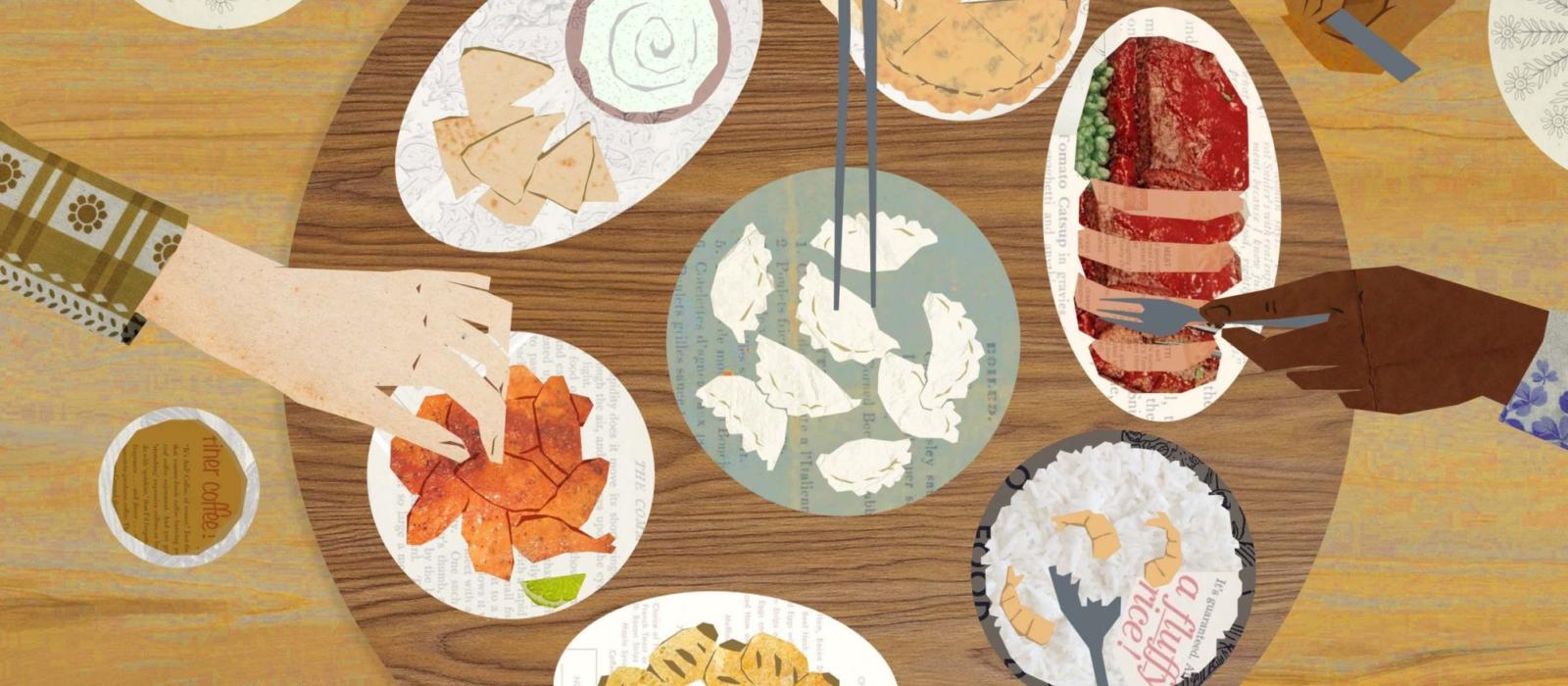
My notion of comfort food may be a result of my particular intersectionality: Southern and Jewish. I grew up on squash casserole, banana pudding and chicken and dumplings, but also fried matzo, creamed herring and gefilte fish. When I got home from kindergarten, there was usually a liverwurst sandwich on pumpernickel waiting for me. But then my mother would make biscuits when she had time, and she’d wrap her meatloaf in bacon and slather it in ketchup; like many Southern Jews, we never ate pork chops – but couldn’t live with-out bacon.
Dinners out were more in the realm of the “exotic” – pu-pu platters (and so much pork) at Chinese restaurants, spinach pies and flaming cheese at Greek ones, and glass noodles and stuffed chicken wings at the one Thai restaurant in town. Our local French restaurant offered a kind of performative exoticism, with its special escargot clamps and its Steak Diane finished tableside in a volatile whoosh of flame and alcohol. There was the division: We went out for the endorphin-rushing, taste-bud-tingling, visually delightful pleasures of dining, but at home we had a more heartfelt connection to food. What we ate at our own dinner table defined us.
Everything about these distinctions disappeared when I moved to Japan for a job after college. I don’t think there’s a place on earth that finds so much emotional succor in a repertoire of familiar dishes. The narrow streets around my commuter train station were filled with tiny counter restaurants, each specializing in its own notion of comfort. There was the fried cutlet place, the curry rice place, the ramen place, the grilled chicken skewer place. As I got to know each one, it would assume ownership of a little piece of my soul.
I brought these experiences to bear when I began writing about food a few years later at the Denver Post. The longtime food editor – a lovely woman who had guided Coloradans through recipes for casseroles, high-altitude snickerdoodles and Thanksgiving turkey for 35 years – had just retired, and the paper was looking to shake things up. So, I came charging out of the gate, a geeky gastronaut, with big plans to move the section out of its cream-of-mushroom-soup past and into the modern world. For one of my first pieces, I wrote about making gyoza – Japan’s great contribution to world dumpling excellence – even including step-by-step dough pleating instructions. Some readers welcomed the change, but many longtime subscribers were aghast. I still remember one call from an elderly woman, her voice quavering with exasperation as she said, “I just don’t like any of this exotic stuff you write about. I only like comfort food.”
To me, comfort was in the maw of the beholder, but this woman was the first of many readers who suggested it was more of a common currency. It’s like they all had a copy of a spiral-bound community cook-book entitled Comfort Foods We Know and Love, and its pages were filled with recipes for pot roast, mashed potatoes (both smooth and lumpy) and those grape jelly meat-balls you make in a Crock-Pot®.
I began to understand that a per-son’s notion of comfort food is less about personal taste and more about what binds them to their culture. For the older and, frankly, mostly white readership of the Denver Post, that was something specific. To appease them I began introducing more recipes for stews, quick desserts that relied on convenience products, and yes, casseroles (though I couldn’t resist slipping some Thai curry paste into one). What I really wanted, however, was to attract newer, more diverse readers – and help my older ones understand that what seems exotic is just someone else’s comfort food.
Now, 25 years later, we live in a time that is both more exciting to dine out in as well as saturated with the emotionally-resonant pleasures of home cooking. So many children of immigrants have come of age, and are remaking today’s American dining world into a thing of intersectional beauty. I now live in Chicago near a funky little bodega where you can buy staples or grab one of the few tables for a quick meal of pizza rolls (a Chicago fav) and pitch-perfect pho developed from the chef’s mom’s recipe. When I open the door and breathe in the warmth of cinnamon and star anise, of simmering stock and grassy herbs, I smell nothing so much as home.