
Article
Free on the Farm
photos by Sarah Rau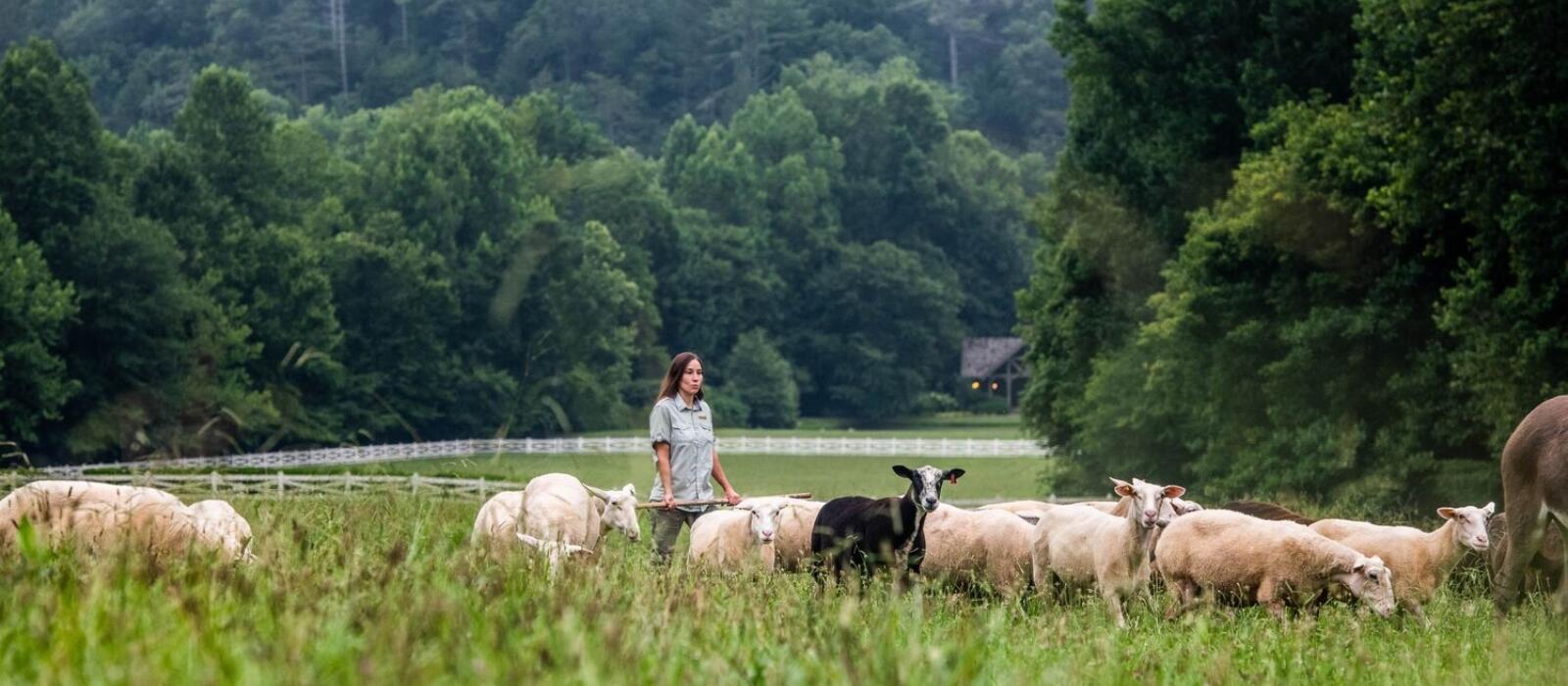
On a cold February morning, while it’s still dark, pregnant ewes munch calmly on alfalfa hay inside their barn. It’s 30 degrees Fahrenheit and wet outside, but their wooly bodies are warm, standing together around the trough or resting in the soft, dry bedding. A set of triplet lambs were just born. They’re tiny – about seven pounds each – and all legs. Their mother is licking them clean. She takes her time and does it well, knowing that they are safe from predators and hypothermia inside the barn. At 5:30 a.m., I walk in and turn on the lights. I make notes of all of the new lambs in my notebook and which ewe they belong to. Are they nursing well? Do they look healthy? Are they so small that they need extra assistance? Is their mother taking good care of them?
The ewes are all used to me. I fed them as babies. I fed their mothers and grandmothers when they were babies as well. They don’t mind me walking through to look at their lambs. Inside the barn, it’s easy for me to be sure that I don’t miss anyone. Some of the ewes are ready to be milked. I open the back doors, and they follow me into the parlor. They line up at the door and enter in the same order that they did yesterday. There’s Sydney in spot number five next to her sister. There’s Delilah in spot 12, and on down the line they go. Sheep love routine, and they’ve come up with this pattern themselves. They lick up the sweet grain in the parlor stalls while I milk them; then they go outside. Once the sun comes up and predators aren’t as active, I open the barn doors for the ewes with young lambs and off er them the choice to go outside. A couple of them run out, kicking up their heels in the cool morning air with their lambs stumbling behind them, but most of them choose to stay inside. About 20 minutes later, I hear the “baas” of the two that went out, letting me know that they have changed their mind. I go back out to let them in their barn, and they push their way through me as I start to open the doors, off ended at how slow I am.
By May, we are well into our milking season. The lambs are weaned, and the sheep are out on rich spring grass. They start grazing before the sun comes up, while it’s still cool out. By 5:30 a.m. they’ve made their way over to the pasture gate and are waiting for me. As I walk up to open the gate, Daphne, the Farm’s gray donkey, makes her way over to survey the situation. She recognizes me and begrudgingly lets me borrow her sheep. If I had been a bear or some other predator that might threaten the sheep, she would have pushed her flock to the other side and come stomping in between, ready to chase me off. Donkeys are powerful protectors.
The sheep know where they’re going even in the dark morning, and they cross the street ahead of me heading for the Dairy Barn. They line up outside the parlor door and wait their turn to come in for milking. They prance excitedly down the parlor floor and turn into their stalls. After milking, I open the gate to let them go back down the road and into the pastures. The sheep lead the way across property and wait patiently for me to put them back into the fence.
Later in the day, it’s gotten hot. The sheep are resting in the shade of the trees, and it’s still a few hours before they need to come up to the barn for the afternoon milking. I notice that one of them is limping, and it isn’t one of the few that like to be caught. I essentially have three options for treating her. One is to try to catch her in the field myself, running here and there, chasing her, startling the other sheep and the donkey, and inevitably being outmaneuvered by her in the end, leaving both of us stressed and panting. The second is to get a bucket of grain and convince all 130 sheep to follow me out of the field, take them on a 15-minute walk in the heat to the corral, where I could shut them into a smaller space and through a chute where I could treat her. This would work, but it takes the sheep away from their grazing time and puts them under more heat stress. The third option is Neza, the border collie. I bring Neza with me into the pasture and ask her to walk close to me. Her focus is fixed on the group of sheep, and she walks slowly and intently toward them.
They notice her immediately and begin to gather closer together. I tell her, “Come bye,” and she runs to the left, swings out and gets behind the sheep so that they are between her and me. The sheep move as a group away from Neza. They start to trail off to the right, but she runs out ahead of them and blocks their path. Neza doesn’t bite or even touch the sheep. She uses her body language to make them want to move away from her and her speed and agility to block all of the wrong paths. Then, the flock of sheep trot over to where I am and stand close to me. I ask Neza to lie down where she is.
The sheep know me, and they are coming to me for protection. They don’t trust that Neza isn’t a predator. Even the sheep that normally avoid being caught will stand still and let me treat them if Neza is around. I pick up the limping sheep’s hoof and see a small stone wedged into a little crack between the hoof wall and the sole. There’s the problem. I trim it out with my shears and spray on a treatment. “That’ll do, Neza,” and we head back out of the field. The ewe is already walking much better, and the herd goes back to grazing.
Freedom is a very emotional word. It is a very human word. I will never truly know what another animal is thinking, but in my experience with livestock, it hasn’t seemed to me that freedom as we consider it is a concept that most of them think about. Rather, “Do I feel safe enough to relax here?” “Do I have access to meet my needs, both physical and mental, here?” Often, it seems that whether or not a space feels large enough or “free” enough to them depends more upon the answers to those questions than on what we as humans might define as free.
Sheep, for example, are prey animals. A sense of safety is important to them. When you observe them in a situation where they don’t feel safe, it will be obvious. Their heads will be held up high and tense, and their ears will be rotating about. They aren’t able to rest like this, and they usually won’t eat or drink either. What domestic sheep value more than wide open space is comfort and a sense of safety. We as caretakers can give that to them in different ways, like ensuring they are always with a companion, giving them a consistent routine and making sure they have ample sources of nutritious food.
One important thing for anyone working with sheep to understand is body language, both the sheep’s and their own. When sheep are in the barn, it is especially important to know how to move in a way that won’t make them panic. That varies greatly from sheep to sheep. Some sheep are very accustomed to humans being close to them and even like cheek scratches. Others have a wide bubble that they want people to stay out of. There are times, of course, where we have to invade that bubble for their own good, like when they need medical treatment, but it’s important to minimize the stress in that invasiveness as much as possible. Having proper equipment and proper knowledge are critical. Often, when moving or sorting sheep, you can set it up so that the location that you want them to go is the most appealing choice. Then, just give them the choice to walk there on their own.
Many people imagine animals roaming in wide open spaces to be the happiest, but that isn’t always the case. Often when those animals are given a choice, they choose what is comfortable and convenient over what we might see as being free. More often, it’s the freedom to engage in natural social behaviors with each other, the freedom to choose between shelter and exploration, the freedom to eat when they want, the freedom that comes with feeling safe and comfortable. Those are the freedoms that make them happy, not the freedom to live without fences.
In fact, that probably isn’t too different from the way a lot of humans feel. We often choose to give up a few of our own freedoms by, say, working a job or following laws, in order to maintain a higher level of comfort. Sometimes we have to take a bit of that freedom away from others if they aren’t capable of making those decisions themselves. I know my toddler would likely choose a lapse in safety over losing freedom by being strapped into a car seat. However, it is my responsibility to protect her and sometimes make choices for her when she doesn’t have a good understanding of the consequences. Taking care of animals could be seen in a similar way. There’s a balance between giving them appropriate choices when you can, and sometimes making choices for them when their health and safety is at stake. At the heart of that balance are respect and understanding.
Want to read more from The Range Issue? Click here to read "Range of Life" by Jeremy Lloyd.