
Article
The Range of Life
photo by William Hereford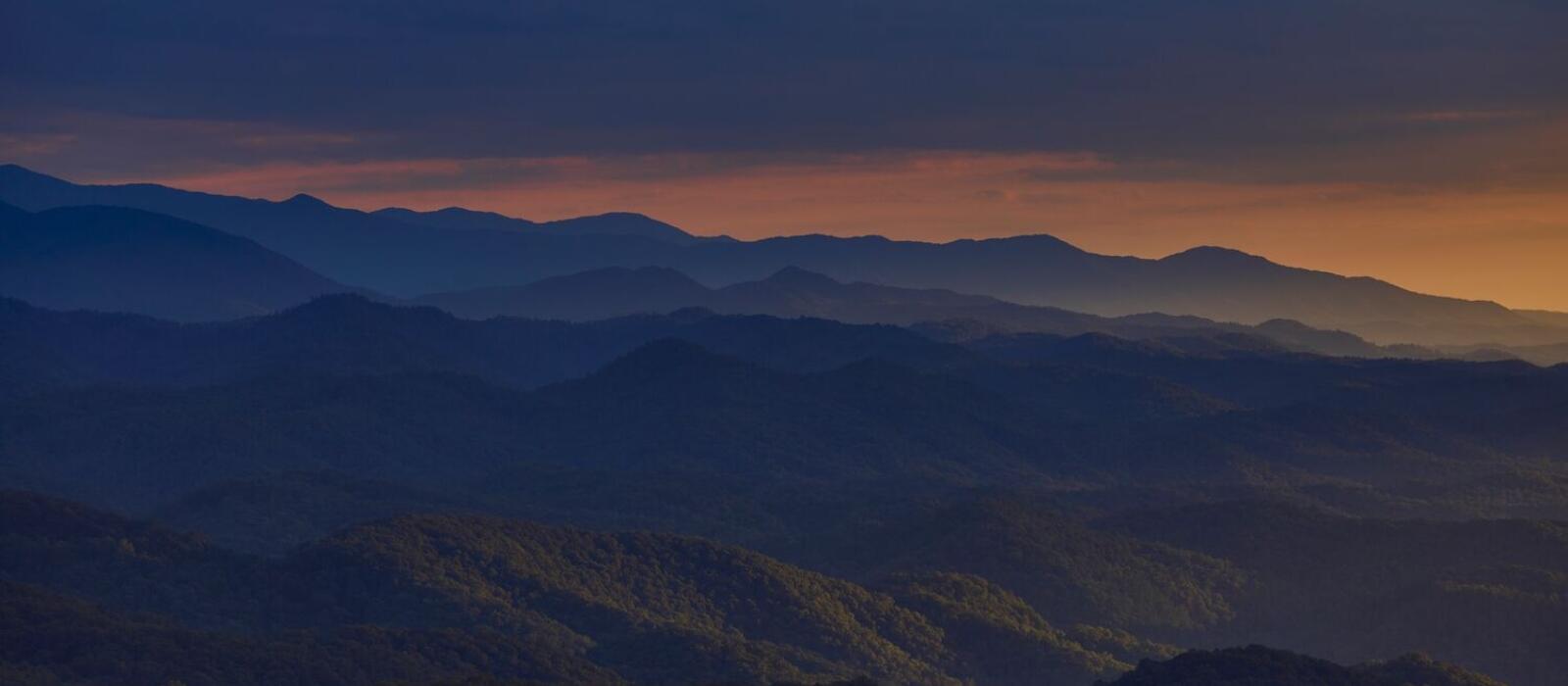
Pop quiz: If Yosemite has Half Dome and Yellowstone has geysers and bison, what makes the Smokies special? Answer: The range of life.
But what does this mean exactly? In scientific terms, it means the Great Smoky Mountains National Park is the most biodiverse ecosystem in North America. In layperson’s terms, it means the Smokies have got the goods on nature. This landmass functions as a living Noah’s Ark filled with biological riches and wonders we are still discovering and documenting.
THE BUILDING BLOCKS OF LIFE
Amazing fact: The Smokies boast more tree species (130) than the entire continent of Europe. Bringing it a little closer to home, if you were to step onto your cabin porch, you would likely be able to spot a greater variety of trees than exist in all of Yellowstone National Park, which has only nine. Why the stark di!erence? For one thing, consider that the American West is far more arid, and many landscapes contained in national parks out there are at a higher elevation, including above the tree line where few organisms can survive. The Smokies, on the other hand, dwell in the humid Southeast where precipitation is abundant in several forms – rain, fog, snow – and where there is no tree line.
Elevation also contributes to the range of life by mimicking latitude. For instance, if you were to drive from Walland, Tennessee, to Kuwohi (formerly Clingmans Dome), which is the highest peak in the Great Smoky Mountains National Park, it would be like traveling from Georgia to Maine. At each stage of elevation, you would spot many of the same plants that you would find along the Appalachian chain if you were to head north.
Also playing a role is landform – the varying and complex shapes of mountain ridges and the “finger” ridges protruding off them – as well as the influence of the most recent Ice Age. Though glaciers never reached this far south, cold temperatures caused many plants and animals to gravitate to a less frigid climate. After finding refuge in the Smokies, many stayed once the Ice Age began to wane and temperatures rewarmed. For instance, Fraser fir and red spruce trees migrated from lower elevations up the sides of mountains until they reached the sky islands where the climate is similar to that of Canada.
Thus the variety of life includes the great panoply of organisms living at all elevations, in every niche habitat, and in every kind of weather the Smokies throw at them.
AT HOME ON THE RANGE
One more testament to the diversity of life in this region is that almost as many different kinds of mammals live in the Great Smoky Mountains as do in the entire state of North Carolina.
For all their ruggedness, the mountains are rather hospitable if you are an animal. And not just any animal, but wildlife.
The word “wild” can be misleading, since, in contemporary usage, it can mean out of control. In a sense, this is true even in the context of wildlife: As untamed creatures, they are indeed self-willed and thus exist outside our control. And a good thing too, since wild animals flourish best by adapting to the cycles of nature and the self-willed landscapes where they are born.
The fact that we see little actual wildlife activity in forests within our region is also a good thing. It means animals are truly wild. Of course, most wildlife isn’t diurnal, or day-active, like birds and squirrels are. The majority of them are nocturnal and make their peregrinations while we humans snooze through the night.
Black bears provide one unique exception. Famous for their voracious appetite, they can be active any time of day or night, catching bear naps in between periods of time spent foraging for berries or nuts. Their range is also larger than most mammals in the Smokies, which makes sense: The larger the animal, the larger its territory.
Animals don’t recognize arbitrary human boundaries, and as a result, many range far outside the relative safety of the national park. This brings up some vital questions having to do with the future of conservation and the health of the Smokies. With human development of once- wild spaces happening all the time, can our range become theirs, and vice versa? Is there enough room for all? What wilderness spaces are we willing to set aside just for them in our towns and yards, while continuing to steward those who have freedom to roam in our national parks?
FINDING LIFE ON EARTH — AND IN THE SMOKIES
Imagine you have inherited a library from a long-lost relative. The only problem is that there’s no record of which books the library contains – no list, no old-fashioned card catalog, nothing. The first thing you’d likely do is find out which books you now own. What scientists call an “all-taxa biodiversity inventory” is something like this, only it’s far more challenging because the “library” is a half-million acres large.
Such an ambitious project began in the Great Smoky Mountains in the 1990s, with the goal of cataloging every living organism in the Smokies. At the start, roughly 9,000 species were known. Since then, the number has more than doubled, with over 11,000 additional species found living in the park. Of these, an astounding 1,092 are new to science.
In short, we don’t need to visit distant planets to discover new plants and animals. We’re still finding them right here. The range of life found in the Smokies is immense, which is something to both celebrate and preserve.