
Story
Tack and Attire: English VS Western, What’s Your Pleasure?
“Tack” is a term used to describe all the equipment that goes on a horse, made mostly of leather and metal. Tack includes saddles, bridles, breast collars, girths, bits, and stirrups. Choice of tack can greatly affect the comfort of rider and beast and has a direct impact on the success (or lack thereof) of the chosen equine endeavor. The choices are endless and the tack catalogs, both English and western, filling the mailboxes of equestrians, make for avid perusal and much discussion. The “tack room,” scented with the essence of fine leather, and a bit of horse sweat, is a favorite hangout!
“Attire” is apparel for the rider. Choice of attire is determined by the sport pursued and varies greatly between equestrian disciplines. For our purposes, attire, like tack, is divided roughly into two categories, English or western. There is some cross over, but most equestrians take an “either/or” approach and sentiments run high. There is a tendency for those on the one side to good naturedly mock the other.
An example: I worked many years as a teacher. One day, over lunch, my principal (former SEC fullback, otherwise known as “Coach”) said to me: “You do that foxhunting thing, don’t you?”
“Ummm, yes”, my reply.
“Do you wear those funny tight pants and that silly hat?”
“Yes”, said I, “You do that football thing, don’t you?.....”
Bazinga! One point for the English side!! Let’s be truly objective – what looks sillier, English riding apparel or a football outfit???? Ha! Though I will confess, my choice of English riding attire would do me little good on the football field, nor would it be ideal for working cattle…
Therefore, as in all sports, form must follow function in choices of equipment and attire.
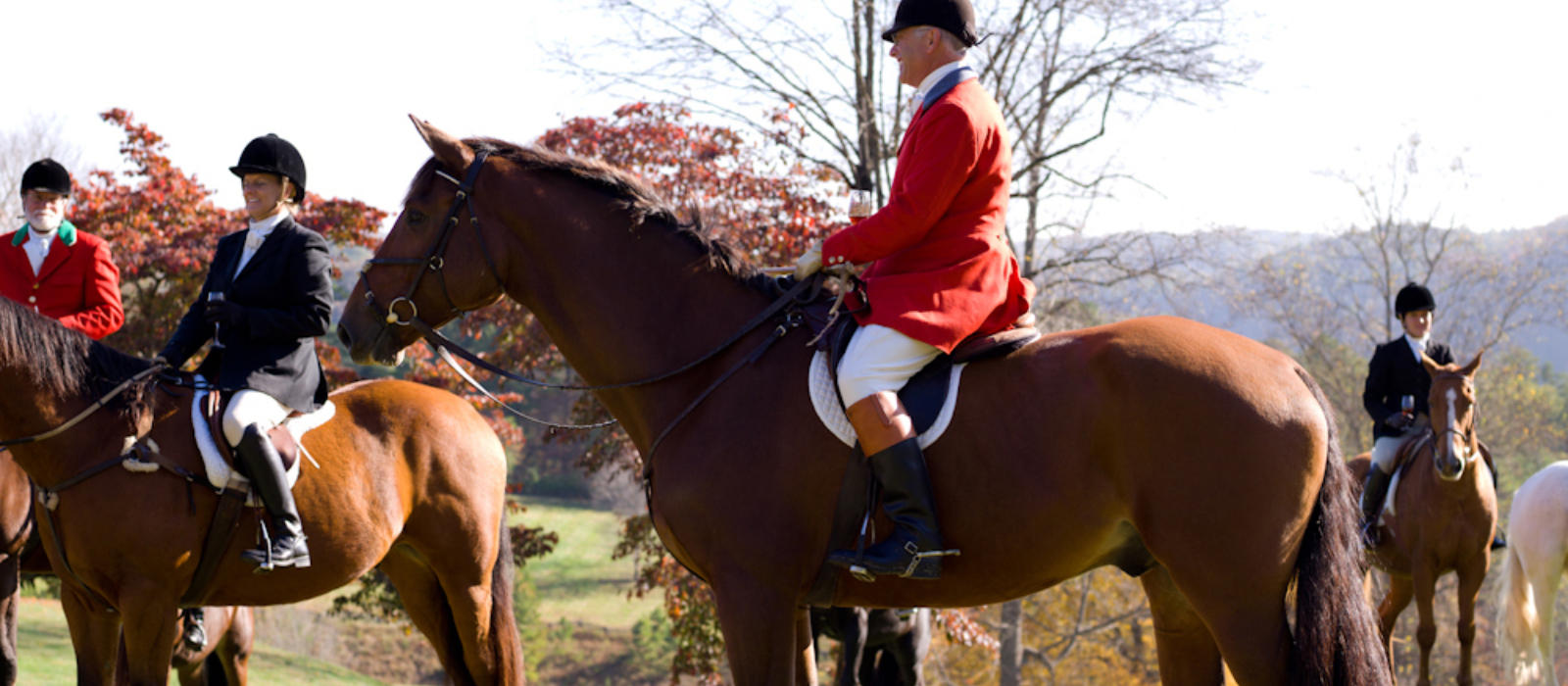
So for riding English, in a formal situation, such as foxhunting, here’s the gear. Both ladies and gentlemen wear a black wool coat in winter, tan breeches, a black velvet riding helmet, white shirt and stock tie, canary vest and tall black boots. Gentlemen who have been awarded the “colors” of the hunt wear scarlet coats (roots in English military), as do lady Masters of Foxhounds of many hunts. This has been standard attire for centuries, is in good taste, traditional and never goes out of fashion. Ladies wearing scarlet is a modern invention and probably the biggest change to standard hunting attire in 300 years, with many holdouts still in opposition! The tack for the English horse is a well-fitted jumping saddle (the English saddle has no horn, for obvious reasons) with a breastcollar, a flat leather bridle, often with rubber reins for grip. The rider will carry a hunting whip with a long lash to alert hounds to stay away from the heels of the horse. The whip will often bear a staghorn handle which can be used to pull closed the farmer’s gate. Emphasis is on well fitting tack, workman like design and simplicity. Other appointments may include wire cutters, in case a horse or hound becomes entangled, and a flask in case celebration is in order.
The western rider, with roots in cattle ranching goes for a different look, also very traditional and suited to purpose. Starting from the top, the hat is distinctive and telling. A “real” cowboy (as opposed to a city slicker dressed up) is readily identified by the style of his hat, and the wear on his boots. The hat shields from sun and rain and fits firmly on the head, not cocked back. The straw hat will have a very tight weave and the felt hat will be of high quality and well formed. A western cut shirt is long sleeved, typically, and will be topped by a vest for warmth and a heavy jacket when needed. Boot cut jeans and chaps are comfortable for long days in the saddle and the standard belt buckle is silver. Appointments include a bandana, roweled spurs, a rope, and a good pocket knife. Custom western boots are a necessity more than a luxury and are prized by the owner. A sturdy stock saddle, fitted to the individual horse, with a horn for roping is a must, and the bridle will have long split reins.
The show ring is a whole different entity for both English and western riders and “the bling thing” becomes part of the picture. Rhinestones and silver figure into both genres, but these things are not necessary to good riding and practical horsemanship.
What it all boils down to is finding well-crafted gear suitable to the job or sport at hand. Despite the obvious differences in outward appearance between English and western disciplines, the most import bit of gear a true horseman can possess is not the hat that reveals his style, but what lies under that hat. It’s not the type of saddle, but the quality of the horse beneath it. No expense of tack or attire will make a true horseman. That essence is gained by miles and experience in a well-fitted saddle, English or western, and a relationship with a good horse.
All great horsemen and horsewomen, regardless of preference in tack and attire, admire good horsemanship. You gotta pull on your boots and saddle up to make that happen!
Please join us.
Carla Hawkinson and her husband, John, are the Equestrian Program Managers at Blackberry Farm. Carla serves as Master of foxhounds for Tennessee Valley Hunt, and has a lifetime of experience in both English and western riding and carriage driving. Contact Carla at chawkinson@blackberryfarm.com or at the Stables, 865-273-8545
“Tack” is a term used to describe all the equipment that goes on a horse, made mostly of leather and metal. Tack includes saddles, bridles, breast collars, girths, bits, and stirrups. Choice of tack can greatly affect the comfort of rider and beast and has a direct impact on the success (or lack thereof) of the chosen equine endeavor. The choices are endless and the tack catalogs, both English and western, filling the mailboxes of equestrians, make for avid perusal and much discussion. The “tack room,” scented with the essence of fine leather, and a bit of horse sweat, is a favorite hangout!
“Attire” is apparel for the rider. Choice of attire is determined by the sport pursued and varies greatly between equestrian disciplines. For our purposes, attire, like tack, is divided roughly into two categories, English or western. There is some cross over, but most equestrians take an “either/or” approach and sentiments run high. There is a tendency for those on the one side to good naturedly mock the other.
An example: I worked many years as a teacher. One day, over lunch, my principal (former SEC fullback, otherwise known as “Coach”) said to me: “You do that foxhunting thing, don’t you?”
“Ummm, yes”, my reply.
“Do you wear those funny tight pants and that silly hat?”
“Yes”, said I, “You do that football thing, don’t you?.....”
Bazinga! One point for the English side!! Let’s be truly objective – what looks sillier, English riding apparel or a football outfit???? Ha! Though I will confess, my choice of English riding attire would do me little good on the football field, nor would it be ideal for working cattle…
Therefore, as in all sports, form must follow function in choices of equipment and attire.
So for riding English, in a formal situation, such as foxhunting, here’s the gear. Both ladies and gentlemen wear a black wool coat in winter, tan breeches, a black velvet riding helmet, white shirt and stock tie, canary vest and tall black boots. Gentlemen who have been awarded the “colors” of the hunt wear scarlet coats (roots in English military), as do lady Masters of Foxhounds of many hunts. This has been standard attire for centuries, is in good taste, traditional and never goes out of fashion. Ladies wearing scarlet is a modern invention and probably the biggest change to standard hunting attire in 300 years, with many holdouts still in opposition! The tack for the English horse is a well-fitted jumping saddle (the English saddle has no horn, for obvious reasons) with a breastcollar, a flat leather bridle, often with rubber reins for grip. The rider will carry a hunting whip with a long lash to alert hounds to stay away from the heels of the horse. The whip will often bear a staghorn handle which can be used to pull closed the farmer’s gate. Emphasis is on well fitting tack, workman like design and simplicity. Other appointments may include wire cutters, in case a horse or hound becomes entangled, and a flask in case celebration is in order.
The western rider, with roots in cattle ranching goes for a different look, also very traditional and suited to purpose. Starting from the top, the hat is distinctive and telling. A “real” cowboy (as opposed to a city slicker dressed up) is readily identified by the style of his hat, and the wear on his boots. The hat shields from sun and rain and fits firmly on the head, not cocked back. The straw hat will have a very tight weave and the felt hat will be of high quality and well formed. A western cut shirt is long sleeved, typically, and will be topped by a vest for warmth and a heavy jacket when needed. Boot cut jeans and chaps are comfortable for long days in the saddle and the standard belt buckle is silver. Appointments include a bandana, roweled spurs, a rope, and a good pocket knife. Custom western boots are a necessity more than a luxury and are prized by the owner. A sturdy stock saddle, fitted to the individual horse, with a horn for roping is a must, and the bridle will have long split reins.
The show ring is a whole different entity for both English and western riders and “the bling thing” becomes part of the picture. Rhinestones and silver figure into both genres, but these things are not necessary to good riding and practical horsemanship.
What it all boils down to is finding well-crafted gear suitable to the job or sport at hand. Despite the obvious differences in outward appearance between English and western disciplines, the most import bit of gear a true horseman can possess is not the hat that reveals his style, but what lies under that hat. It’s not the type of saddle, but the quality of the horse beneath it. No expense of tack or attire will make a true horseman. That essence is gained by miles and experience in a well-fitted saddle, English or western, and a relationship with a good horse.
All great horsemen and horsewomen, regardless of preference in tack and attire, admire good horsemanship. You gotta pull on your boots and saddle up to make that happen!
Please join us.
Carla Hawkinson and her husband, John, are the Equestrian Program Managers at Blackberry Farm. Carla serves as Master of foxhounds for Tennessee Valley Hunt, and has a lifetime of experience in both English and western riding and carriage driving. Contact Carla at chawkinson@blackberryfarm.com or at the Stables, 865-273-8545