
Story
Peppers
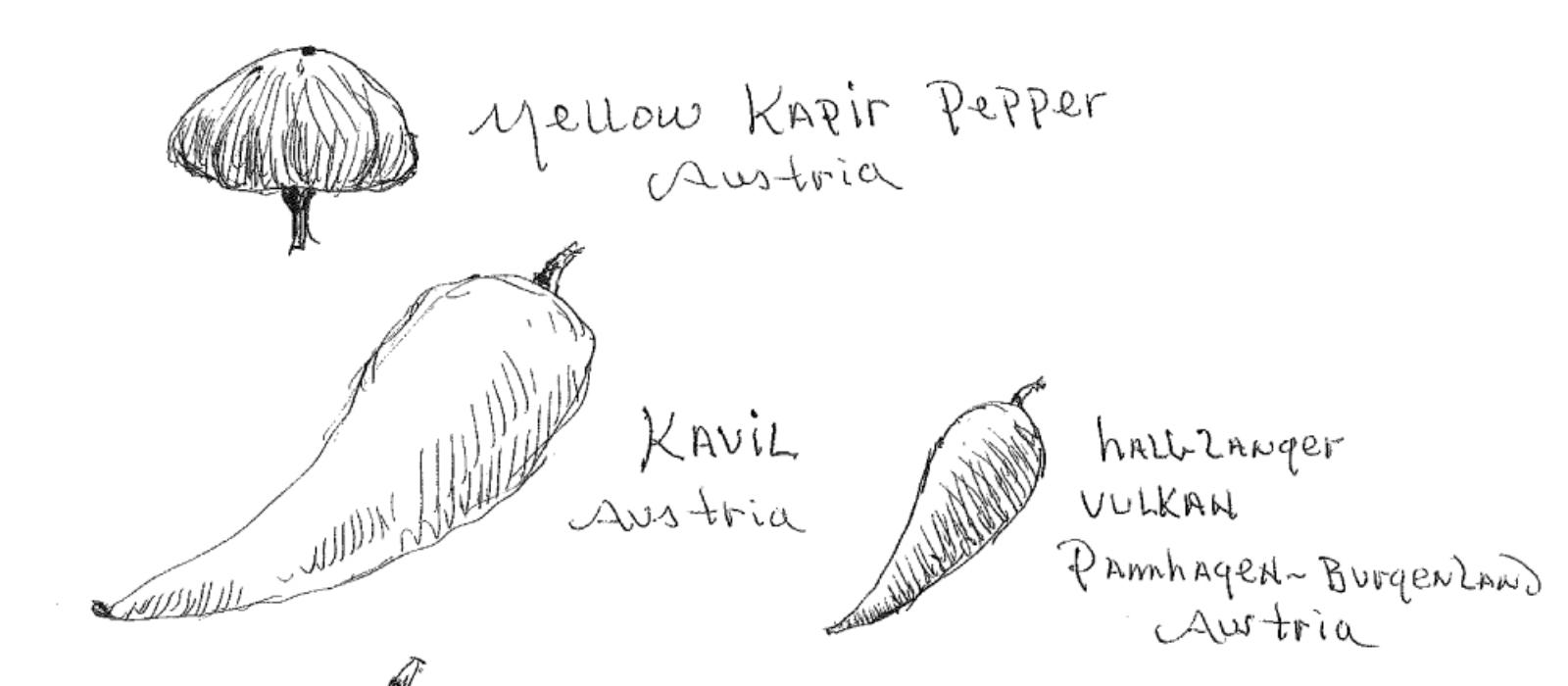
The Kavil and Kavir types are from 8 to 10 inches in length and somewhat flattened in shape while wide at the stem end and taper to a point. These peppers are medium thick fleshed and mature to a deep red color. The peppers are sweet to the taste and hold their texture well when cooked, stuffed or when used fresh in salads.
The Neusiedle pepper is similar in shape to the Bell pepper types but had a much thinner hull and is less “watery.” This pepper holds up very well when stuffed with rice, pork, paprika, tomato sauce, onion, garlic, etc., and holds its shape well during the baking process.
A farmer friend of mine in Pamhagen, Burgenland, told me that he had raised a good number of Bell peppers and that nobody liked them because they were too thick and watery and not suited for their uses. The Kapir pepper is cone shaped, round and grown upright on the plant. They are a bright, light yellow color and are often used for pickling. I remember large jars of them stuffed with sauerkraut and pickled.
As well as being used fresh in season, many of the varieties are also used to make winter salads. One of my favorites was made in October when the fall harvest was at its height. The red peppers are quartered and simmered in a solution of water, vinegar, sugar, peppercorns, bay heat, allspice, sliced onion, celery leaf and sliced carrot for ten minutes. When finished, the peppers were put into jars and covered with the liquid and enough oil to cover to the top of the jar. The jars were then covered with wax paper and tied with string and placed on shelves along with beet salad and pickled stuffed peppers to be eaten during the long winter months.
During my time spent in remote farming areas of Romania in 2009, I collected a good number of pepper varieties that have been added to the collection. Some of the varieties were similar to those collected in Austria and Hungary, and there were other types that I had not seen before. Along with these new varieties, there were also new recipes and uses for the varieties. I anxiously await their maturity so that I can try some of the new recipes and make winter salads like the ones that some of the women taught me how to make.
John Coykendall, Master Gardener Over the years, peppers have been one of my favorite crops to grow. Some of my favorites are the hot varieties which range all the way from a mild heat to volcanic on the heat scale. I prefer the mild to medium heat range rather than chewing on a Habanero Chile to prove your macho worth as smoke pours from your ears and nostrils. There are a number of sweet varieties that I have grown for many years as well and all of them are used in a variety of ways. Most of the peppers that I have were collected in Austria, Hungary and Romania. Many of the varieties from those countries are quite different from the ones that we are familiar with here in America. Some of the sweet varieties that I have from Austria include the Kavil, Kavir, Paprika Neusiedle, Paradeis Paprika, and Kapir.
The Kavil and Kavir types are from 8 to 10 inches in length and somewhat flattened in shape while wide at the stem end and taper to a point. These peppers are medium thick fleshed and mature to a deep red color. The peppers are sweet to the taste and hold their texture well when cooked, stuffed or when used fresh in salads.
The Neusiedle pepper is similar in shape to the Bell pepper types but had a much thinner hull and is less “watery.” This pepper holds up very well when stuffed with rice, pork, paprika, tomato sauce, onion, garlic, etc., and holds its shape well during the baking process.
A farmer friend of mine in Pamhagen, Burgenland, told me that he had raised a good number of Bell peppers and that nobody liked them because they were too thick and watery and not suited for their uses. The Kapir pepper is cone shaped, round and grown upright on the plant. They are a bright, light yellow color and are often used for pickling. I remember large jars of them stuffed with sauerkraut and pickled.
As well as being used fresh in season, many of the varieties are also used to make winter salads. One of my favorites was made in October when the fall harvest was at its height. The red peppers are quartered and simmered in a solution of water, vinegar, sugar, peppercorns, bay heat, allspice, sliced onion, celery leaf and sliced carrot for ten minutes. When finished, the peppers were put into jars and covered with the liquid and enough oil to cover to the top of the jar. The jars were then covered with wax paper and tied with string and placed on shelves along with beet salad and pickled stuffed peppers to be eaten during the long winter months.
During my time spent in remote farming areas of Romania in 2009, I collected a good number of pepper varieties that have been added to the collection. Some of the varieties were similar to those collected in Austria and Hungary, and there were other types that I had not seen before. Along with these new varieties, there were also new recipes and uses for the varieties. I anxiously await their maturity so that I can try some of the new recipes and make winter salads like the ones that some of the women taught me how to make.
John Coykendall, Master Gardener