
Article
Harmonious Contrasts
photo by Reid Long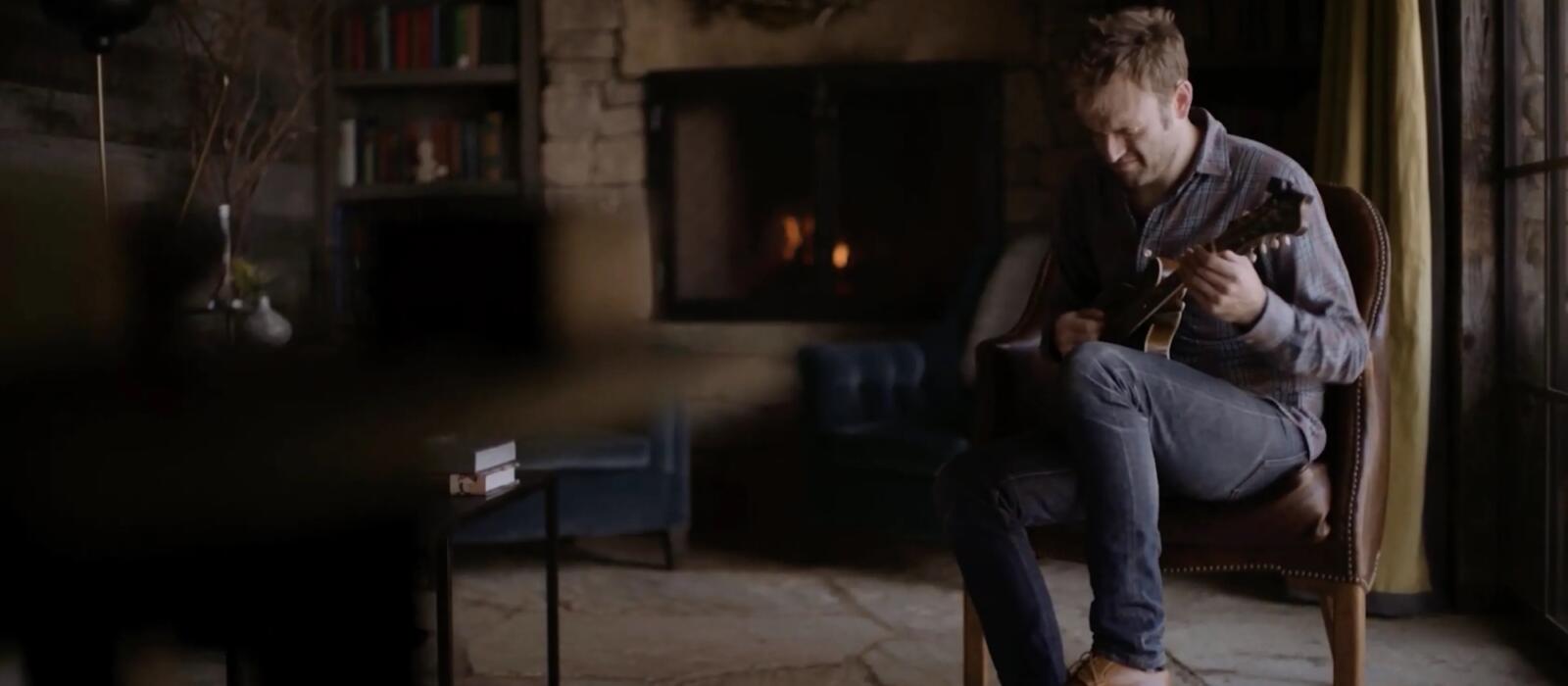
Like every instrument, the mandolin has its own peculiar character and timbre – texture, if you will. The instrument has almost no sustain, which is where that plinky quality comes from: When you strike a note on a mandolin, it dissipates in a hurry. Mandolin players get around this handicap by employing a rapid picking technique called tremolo, which sounds like the beating of a bird’s wings. It gives the illusion of sustain and allows mandolin players to approximate the swerving, sinuous lines of a violin. It can also put you in mind of The Bay of Naples by Moonlight. In the context of digital-age recording, the mandolin adds aura and patina, the heft and hew of the handmade. Its singular texture is unmistakable, yet it gives the descriptive shorthand of the English language a run for its money. We grope for the right words: “woody,” “barky,” “chirpy.”
“It is woody,” the 40-year-old mandolin virtuoso Chris Thile said when I asked him about the mandolin’s idiosyncratic texture. “And it can be shrill.” It’s not exactly the stuff of great promise. But for Chris, a prodigy who has earned four Grammys for his work with Nickel Creek, Punch Brothers, Goat Rodeo, and the bassist Edgar Meyer, not to mention a 2012 MacArthur Foundation “genius grant,” there’s an upside: In the right hands, i.e., his, limits can be liberating. “When I sit down with the mandolin, I’m actually pretty giddy about the amount of limitation,” he told me.
“That little booger does not present a ton of options! You’ll exhaust what’s been done pretty quickly as a curious, facile player. But then you go hunting. And that’s so much fun.”
The hunt has taken Chris on a far-flung search for new sounds, new textures. His playing is virtuosic, yes, but more important, it’s interesting. He can make his 1924 Gibson F-5 mandolin sound elegiac or randy, wheedling or torrential. His music can be as earthy as Dock Boggs, as fluid as Miles Davis and as pointy as Schoenberg. The freewheeling vernacular of Americana is melded with the exploratory flights of jazz and the formality of classical. On his recent solo album, Laysongs, released last summer, it’s all right there – Chris, unaccompanied, going through aluminous song cycle that, as the title might suggest, traces an open-hearted agnostic’s reckoning with all things spiritual. In such a bare setting, you’d think the mandolin’s limitations would show even more. But listen to “God Is Alive Magic Is Afoot” and hear Chris unleash a five-minute storm of improbable, contrasting textures: muted strums, percussive pops, abrasive scrapings, and scurrying, rapid-fire runs. Each seems to accentuate the other. “In music,” Chris said, “texture is achieved by juxtaposition. That’s how we even begin to perceive texture at all.”
Some Chris Thile 101: From the age of two, he would be taken to bluegrass shows at a pizzeria in Carlsbad, California, near his family’s home, where he’d beat time on his high chair; by the time he was five, he was begging for a mandolin. Not long after, he had an actual mandolin in his hands and, over the course of a week, figured out how to play it. Soon he was connecting with the similarly precocious siblings Sara and SeanWatkins, with whom he founded Nickel Creek in 1989 under the guidance of his bass-player father, Scott E. Thile, an instrument technician. (The elder Thile had a Christian awakening when Chris was eight, which meant worship, home-schooling, and continued immersion in music.) A string of celebrated bluegrass records followed, along with Chris’s own solo work, starting with his debut, Leading Off, in 1994. On the cover, the 13-year-old phenom looked like a prototypical little leaguer, which he also was. Entering his teens, Chris got deeper into jazz – Stéphane Grappelli, Joe Pass and the beguiling, seductive sounds of Stan Getz and João Gilberto. Before Chris qualified for his learner’s permit, he was being anointed as the avatar of a new era of mandolin, the heir apparent to such exalted precursors as the father of bluegrass, Bill Monroe, and the new grass pioneers David Grisman and Sam Bush.
Chris kept pushing forward, kept hunting. There was Punch Brothers, a prog-grass outfit given more to art songs than reels, as if the Stanley Brothers had gone on a Stravinsky binge. Goat Rodeo followed, an all-star troupe of string virtuosi, such as the cellist Yo-Yo Ma, with little regard for genre demarcations. Chris drew comparisons to Astor Piazzolla for his flair in taking a vernacular style – tango for Piazzolla, bluegrass for Thile – and elevating it to the level of concert music. It was only natural. Chris had also sucked up classical music like a sponge, including Bach as played by the pianist Glenn Gould and the violinist Arthur Grumiaux, whose recordings of Bach’s sonatas and partitas eventually inspired Chris’s own masterful 2013 album of those pieces. Along the way, he managed, for four years, to be the genial host of Live from Here, the National Public Radio music-variety program that spun off from Prairie Home Companion. He got married (at Blackberry Farm, in fact), started a family, and settled in Brooklyn.
For Chris, having spent a lifetime in music, so much comes down to texture. “Genre,” he said, “is just a conversation about texture – the surface sound of a thing.” Thus, the superficial boundaries dividing bluegrass, jazz, pop and classical melt away. Chris is forever searching outside of music for analogous experiences – textures, really – that resonate and inspire. Food and drink are “constant sources of textural inspiration” – a dinner at Alinea, in Chicago, say, or a great old Burgundy, with its layers of taste and feel, terroir, and history. “It behooves us as music lovers,” he said, “to observe how texture functions across all the arts, including the edible arts and the wearable arts and the viewable arts.” Chris finds the recording studio to be a textural wonderland.“ All the options are there,” he said, “like a spice cabinet the size of the New York Public Library.” The temptation to go overboard is intense. “Ultimately a lot of music these days ends up sounding like a bag of nacho-cheese Doritos – highly manipulated.” He’d prefer his own recorded music to go over like a well-grown tomato, simply dressed. The texture is enhanced, not concocted.
That kind of easy simplicity is typically the result of serious labor. The contrast between heroic striving and seeming effortlessness is itself an indelible texture, perhaps the one Chris loves the most. “Music, after all, is an art of contrasts, of surprising and satisfying contrasts,” he said, his own music being a prime example, with its ever-contradictory, ever-evolving textures. “That is the goal:to surprise and still satisfy. I’ll be an uptight person if I’m never being surprised and only satisfied.”
Watch Chris Thile's Blackberry Sessions