
Article
Disconnected
photos by Sean Brock
As Mom and I head into the Cumberland Mountains just south of the Kentucky-Tennessee border, the memories start kicking in. I’m a kid back in the early 1980s, lying in the backseat of my parents’ station wagon on our way to vacation in Gatlinburg or Hilton Head. I’m doing MadLibs or reading comic books, quietly listening to my father’s cassette tapes of Vivaldi or Mozart or Strauss in our Pontiac wagon. There’s the hum of the old V-8 engine; there’s a billboard advertising a family-owned steakhouse that’s probably long gone by now. Mom is navigating with a fold-out gas station map, our route highlighted with a red felt-tip pen. My parents’ conversations are quiet. Sometimes, we get lost.
More than 40 years later, this current trip with Mom is a reminder of how much life has changed. I thought it would be relaxing – a chance for the two of us to catch up. She’s 75 now, splitting her time between New Smyrna Beach, Florida, and her boyfriend’s place in Cincinnati, where I live. I’m just a few months shy of 50, married with a young child of my own. Mom doesn’t like to travel alone, so I agreed to drive her down to Florida, then rent a van to take back some furniture she has for our new house. I thought it would be a return to the old days, back when road trips were escapes and dad was still alive. But I learn quickly that, in this era of smartphones, smart cars, smart apps and smart navigation systems, escapes are hard to come by.
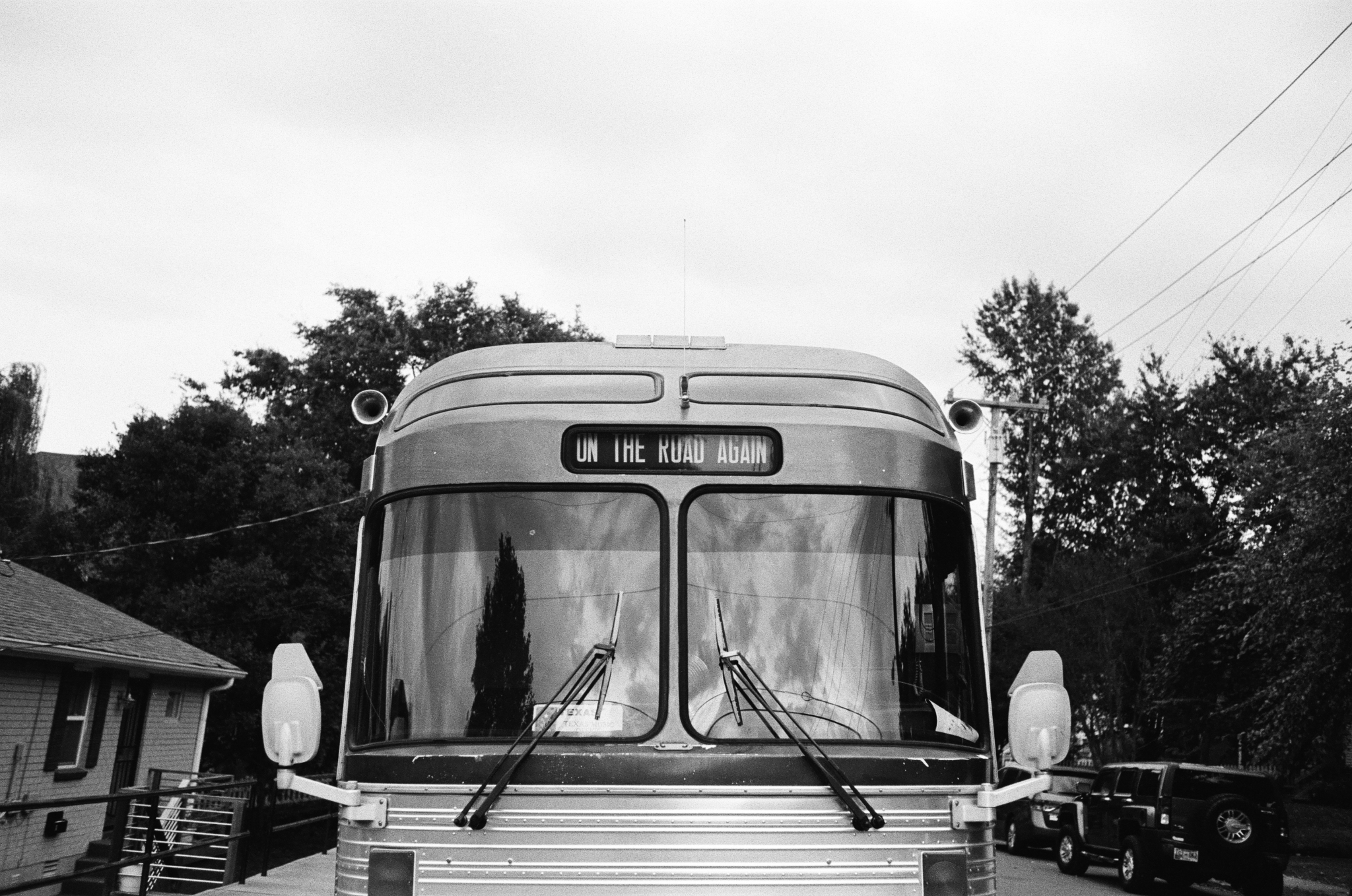
The photos used in this article were shot on film with a vintage Leica by chef, photographer and Blackberry friend Sean Brock.
That lesson begins as soon as we cross the Ohio River from Cincinnati into northern Kentucky. A fight breaks out. Not between me and Mom, mind you, but between me and the touchscreen of Mom’s new SUV. More than the Ford or the Subaru I have at home, it’s operated almost entirely through a touchscreen. No knobs. No buttons, just one screen that controls the camera system and the navigation system, the climate controls, and the “info-tainment system.” As I try and set the mood for the trip – to find the right music and the right temperature – my eyes dart back and forth from the screen to the road so often that I begin to swerve as poor Mom keeps yelling, “Jesus Christ.”
Meanwhile, the directions streaming from my phone’s Apple Maps app contradict those blaring from Mom’s Waze app. I ask her to turn it off, but she doesn’t know how. My phone keeps vibrating with text messages and Facebook messages and Instagram messages, and the only classical music on this trip is from Mom’s clamorous “Ode to Joy” ringtone that is set at such a high volume that it startles me whenever someone, usually Mom’s boyfriend, calls – meaning I’ll be subjected to one of their “Are you still there? Are you still there?” personal conversations.
It doesn’t help that, whenever we pull off the highway for gas or food, I immediately check my social media accounts to see who liked what, who shared what, and who’s sparring on Twitter. Then it’s on to CNN, The New York Times and The Washington Post, where I am sucked into the partisan commentary that’s replaced actual news during the past decade or so. I can feel my blood pressure rising; I can feel my mind lose focus. Here, in the peace and quiet of these beautiful mountains, my mind is anything but.
Like a lot of people, I worry about the toll technology is taking on me, my sense of identity, my personal relationships, my soul. I’m embarrassed by the anger social media can trigger in me; I’m ashamed of the mindless hours I spend watching YouTube videos of “Famous Comedians Vs Hecklers,” or “The Most Awkward Interview Moments on Talk Shows.” It’s not all bad, of course. I met my wife, Amy, on a dating app, and when we realized we couldn’t have a child on our own, our daughter was born with help from the technological miracle of IVF. If it weren’t for technology, my life wouldn’t be what it is today. Still, I wonder if it’s preventing life from being all that it could be.
I’m forgetting how to do the simple things: things like reading a map, talking on the phone, writing a letter to a friend so he knows I’m still thankful for his friendship. Now that I do my shopping online, I miss the department store salesman who used to give me updates on his kids, and the decline of department stores. Now that I do my banking online, I miss the teller who always doted on me until one day, I was told she was sick, and she never came back. I miss listening to local radio stations with their inside jokes about the city and its leaders. I miss getting the news from an hour of NPR in the morning, 30 minutes of NBC Nightly News at 6:30 p.m., and leaving it at that.
Sometimes, when it’s all too much, Amy tells me to take a walk, which I often do. I put on an old pair of grass-stained sneakers and head toward the nicer parts of our neighborhood to gaze at its old Tudor and stone houses. I feel the weather; I note a glimpse of sunshine or some storm clouds on the way. Sometimes I take the dog with me and wonder what she’s sniffing at, why she stops sometimes and tries to pull me back toward home. Our destination is usually a tranquil canopied pathway that the kids at the nearby high school use as a shortcut from Erie Avenue to Observatory. It’s such a simple thing to do, but it puts everything back in perspective. It resets my mind. It saves me.
When Mom and I reach New Smyrna Beach, I try to take Amy’s words to heart. I log out of my social media accounts, shut down my laptop and turn off my phone. I spend three days taking long walks, riding an old cruiser bicycle and reading books. In the evenings and at lunchtime, Mom and I take her old golf cart along the rolling greens toward the clubhouse, and we finally begin to talk. To really talk.
When it’s time to leave Florida, I rent the most bare-bones minivan I can find; one with lots of knobs and buttons. There’s even a CD player. Since the van is still Bluetooth enabled, I think about syncing my phone and turning on the navigation system. But then I realize that I’ve made this drive three dozen times or more. I don’t need directions. I know my way home.