
Article
Cradled in the Canopy
photos by Ingalls Photography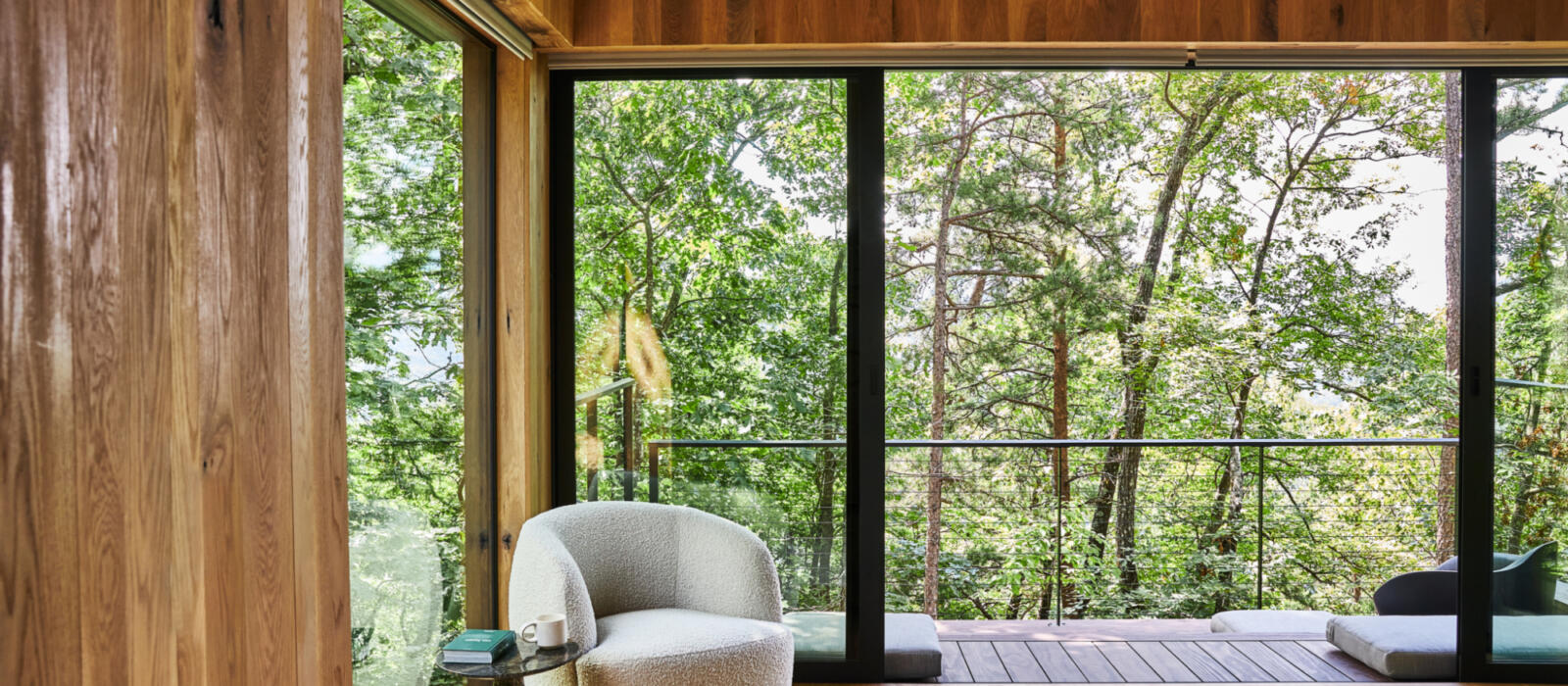
Picture this. You’ve climbed up, abandoned terra firma, and nestled comfortably in the trees. There, your senses are awakened by cooler air, the warbling of birds and rustling of leaves, and the warmth of spackled sunlight peeking from between branches to dance on your face.
Elevated, you feel a world away from life below. The connection to the natural world inspires a heightened sense of wonder, creativity and freedom.
While this may sound like an escape to a magical childhood treehouse, it’s actually the atmosphere generated by a more refined endeavor. This is the reality of a stay in the latest guest accommodation at Blackberry Mountain, the Treehouses — a collection of 14 private buildings on the Mountain, situated on a heavily wooded ridge near the Lodge.
“Every space has a connection with the land,” said Director of Design Jason Bell. At the Farm, he explained, the colors and rolling terrain of the Great Smoky Mountain foothills are the main inspiration. On the Mountain, it’s the sky and trees. “At some of the higher elevations, you’ll sometimes be over the clouds, and there’s almost a disconnect from life below,” he said.
From the outside, the Treehouses’ rough-hewn black and natural wood exteriors, sloped rooftops and generous use of glass make them a unique addition to Blackberry’s architecture. Inside, unadorned white oak covers the floors, walls and ceilings. During my stay, I was given a Treehouse with a white oak king bed floating in the main space, situated to face an all-glass front wall with sliding glass doors that open to a three-tiered outdoor deck, complete with custom-made pillows that allow you to lounge among the treetops.
This respect for and deference to the natural beauty outside every Blackberry door is something that Jason and Assistant Director of Design Samantha Feuer refer to repeatedly in their work. The key to Blackberry’s thoughtful design of the Treehouses is based on the idea of using nature as a guide to “bring the outside in.”
With such a dynamic view, moderation rules inside. The team was inspired by the restraint associated with Eastern design, especially the modern work of George Nakashima, the Japanese American designer who was one of the leaders of the American craft movement of the early 19th century. “He based his designs on the idea of being zen. He played up what was outdoors and didn’t try to compete with it. That’s exactly what we were going for,” said Samantha.
What the team’s minimalist approach lacked in extraneous detail was made up for by its integration of interesting texture. At the head of the beds, pillows are covered in nubby linen; at the foot lies a soft alpaca throw in an on-point hunter green – one of the few concessions to color in the space. In my space, a rusty-colored marble drinks table is flanked by a pair of swivel chairs covered in natty boucle fabric.
Art abounds in almost every space at Blackberry. But in the Treehouses, the connection to light and the outdoors means more glass and less art. In my room, there were just three pieces – a photograph of a woman’s lingering aura near the front door; a framed collection of smooth colored rocks in the bathroom (“We found them in one of those witchy crystal shops,” said Samantha); and a topographic survey by Marie Laforey, made from dried moss, above the bathtub.
This was, of course, intentional. “What we did was minimize the interior to maximize what you're looking at outside,” Jason said. They let the natural world take the forefront. For the same reason, there are no window treatments other than remote controlled privacy scrims that drop from the ceiling.
Blackberry proprietor Mary Celeste Beall says the Treehouses were a natural addition to their existing mix of buildings. “The ridgeline seemed like the perfect place for guests to be perched in the trees, calling for our version of a treehouse,” she said. “They create an opportunity for guests to enjoy the feeling of a faraway forest escape, while remaining close to the property and experiences available around them.”
The architecture team configured an environmentally sound plan for building the Treehouses that involved removing the fewest number of trees possible and positioning the site for the lowest impact on the land. “Without a poured foundation, the impact of the structure on the land is minimal,” Jason said. “Keith [Summerour, the project’s architect] designed simple support posts to blend in with the tall tree trunks surrounding them.” Keith also created a graduated deck so that the view of the Smoky Mountains isn’t lost for those inside when someone else might be enjoying time there.
I didn’t have that problem. I was alone in my Treehouse getaway, which allowed me to sit on my bed at dusk, wrapped in a soft alpaca blanket, and watch the light change in the room as the sun slipped slowly between the hills just beyond the thick curtain of leaves outside. A few hours earlier, a summer storm had rolled in; with my sliding glass doors wide open, I could hear and smell it coming long before the raindrops started their staccato.
In both instances, I witnessed first-hand the pay-off of a design theory which allows the natural beauty outside to be the star of an interior space.
I usually need the drone of a TV show in the background to get to sleep. That night, the hidden screen in my treehouse remained behind its white oak panel, and I drifted off listening to a beautiful cacophony of cheeping crickets and clicking tree frogs. I slept with the shades up, so that in the morning, I could lie in bed and watch as the dark, thin silhouettes of the trees gradually emerged against the brightening sky – nature’s own gallery, rising right before my eyes.