
Story
Life After Death
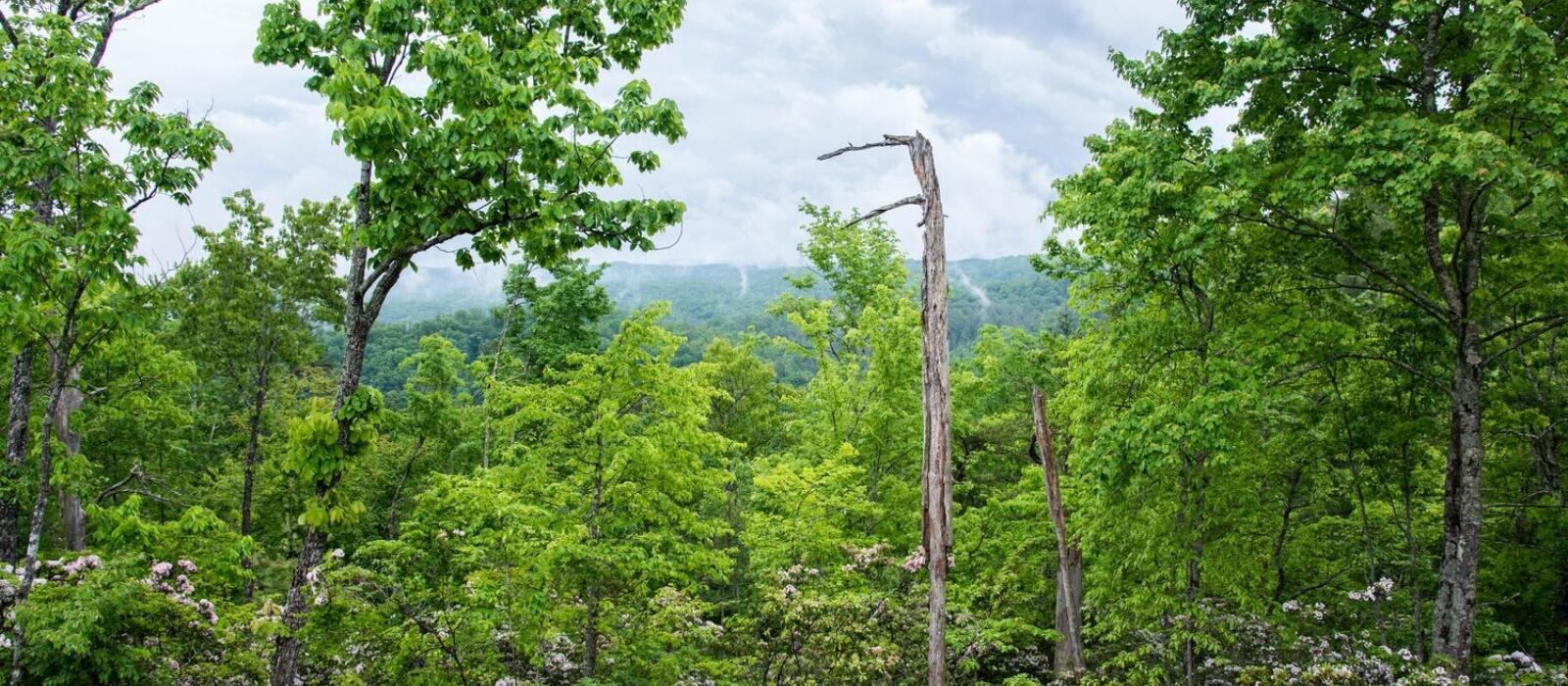
As a lifelong naturalist, one thing that has become very obvious to me over the years is that the natural world, in many ways, is a shadow and reflection of the supernatural one. There are some phenomena here at Blackberry Mountain that illustrate this theme to great effect. If one were to go for a leisurely stroll along Double Branch Nature Trail, keeping company with the murmuring waters of Double Branch itself, it is very likely that these illustrations would be encountered. A cursory glance around will reveal that there are a number of trees growing on "stilts". In other words, they are growing in such a way that they stand high off the ground supported by their roots, looking to all the world as if they may walk stealthily away once you turn your back! Elsewhere, you may see up to half a dozen trees standing neatly in rows as if some long-forgotten shepherd of the forest had planted them that way. Birches and hemlocks are especially prone to this sort of behavior, but other species will happily join in the fun as well. So, what gives? How do these things come to be? “Someone” has to die.
In a forest with no death, life comes to a standstill – time stops. You see, for every four and a half square feet of forest floor in our eastern forests, there are approximately 2,200 tree seeds just waiting for their chance to germinate and grow. Most of them will never have the chance. Why? Well, they have needs that must be met. If these needs are never met, they will never grow. First, they need sunlight. Second, they require adequate moisture. Finally, they need direct contact with the soil or some other suitable substrate. In a mature forest with a fully developed canopy, all three of these things are in short supply and competition is fierce. What could possibly make more available? Well, fire, for one. When an intense forest fire ravages a forest, it consumes the excess organic material on the forest floor, eliminates many of the herbs and shrubs in the understory, and sometimes even kills mature trees that help make up the overstory or "roof" of the forest. This sort of clearing is most beneficial to serotinous species. These are specialist that are capable of waiting many years for a catastrophic fire event, at which time they will release their seeds into a world purged of competition. Table mountain pines, pitch pines and fire cherries are good examples of such species. A more benevolent catalyst for new growth in our forest is the passing of an individual climax tree. These are large, mature trees that occupy prominent positions in the canopy and monopolize a significant portion of area on the forest floor with their roots and associated fungal network. The causes of their demise are many and varied. It could be as simple as death from advanced age or as dramatic as a lightning strike. Whatever the cause, they have died, and their return to the forest floor precipitates the next series of events. Some blustery night, a strong gust of wind will catch them just right, and, with a rush and snapping of branches, the earth will welcome them back from their long sojourn in the heavens. The monarch returned to the garden. The swirling leaves and dust will settle. The frightened birds will regain their confidence and return to investigate, and silence will once again reign supreme.
And yet...
Seasons will come and go. Moisture from rain and snow, beetles, woodpeckers, fungi, the whole of the understory kingdom will do its work. Gently, quietly, unceasingly the miracle will transpire. The great trunk will soften and decay, a rich, moist raised bed, if you will, its fifty-foot length exalted ever so slightly above the surrounding vegetation. It is gently bathed in sunlight that filters in through the gaping hole that it tore in the sky when it fell. A thin layer of moss, lichen and algae covers it from stem to stern. Meanwhile, its sister trees stand about like mourners at its side, dropping seeds of remembrance as if they were offerings of flowers. Most of these will fall past the decaying log and be lost in the gloam of the forest floor. There, in the underbrush and fallen leaves, they will dwell in limbo, hidden from the sun and insulated away from the soil. A select few though, will land in utopia. Trees and herbs will sprout up along the top of this "nurse log" for its entire length, sending their roots down into the decaying wood and eventually all the way down into the soil. What was dead is now alive again. What was fallen is about to be raised. These young seedlings will become sentinels of the forest standing in tidy rows, their branches like uplifted arms reaching for the light. And the existence and benefits of the tree that could have simply been seen as dead is undeniably evident in all that grow after it and as a result of it.
– Boyd Hopkins, Blackberry Mountain Head Naturalist