
Story
Legends of the Fall
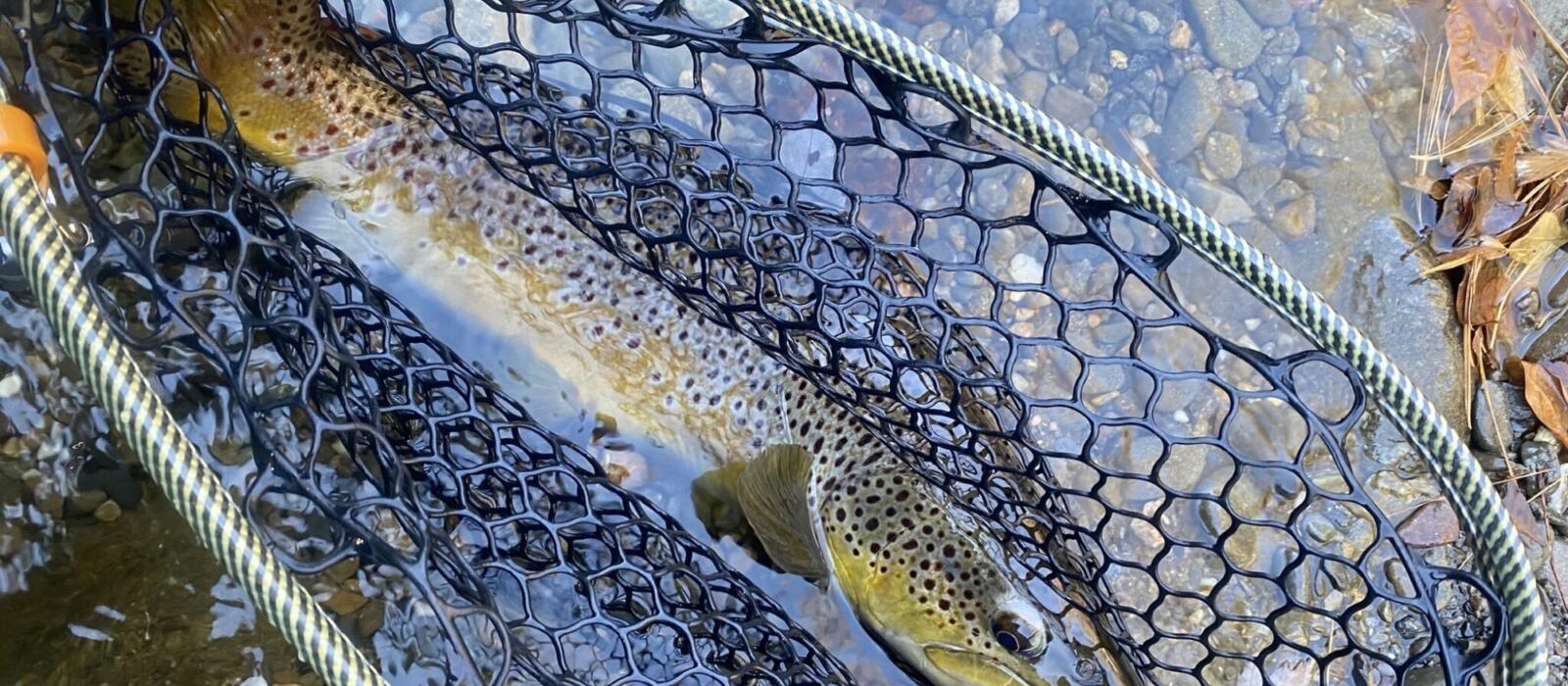
A true fly angler perceives the world in watersheds. The Little River Watershed – where Blackberry Farm and Blackberry Mountain find their home – begins at the highest point in the Great Smoky Mountains National Park, at 6,643 feet in elevation, as rain wets the Northwest slope of Clingmans Dome. After reaching the ground, these raindrops will descend another 5,830 vertical feet to Little River’s confluence, with the Tennessee River at 813 feet above sea level. During this journey of approximately 60 miles, Little River flows through three counties, is supplemented by 141 tributaries, and washes the remnants of countless regional secrets. Among these are forgotten low head dams, foundations of CCC lodging and area aristocrats’ former Summer homes, and bits of train track left as a reminder of the logging industry which once decimated what would become the nation’s most visited national park. However, through the eyes of a fly angler, the most spectacular of the secret treasures lying in the Little River Watershed are the legends of the Fall – large, wild brown trout, Salmo trutta.
Not unlike many other cool, freestone mountain streams across the country, Little River is home to a population of wild brown trout – a species native to Europe – once stocked here and now naturally reproducing in the bounds of the Great Smoky Mountains National Park. What is special about this fishery lies in the natural phenomena that necessitate the rarity of large mature specimens. First of all, a combination of high gradient streams, Fall droughts and torrential Winter rains result in very poor spawning success for brown trout in the Smokies, particularly on the westward facing slopes. This has led to Little River being effectively the only stream where these fish still exist on the Tennessee side of the GSMNP, as well as causing them to be far outnumbered by rainbow trout whose spawning behaviors are better suited for this environment. The second of these phenomena being that the Smokies are what we call a “food starved environment”, meaning a lack of aquatic insects – a result of incredibly old streams and falling Ph – is the primary limiting factor for the carrying capacity of our streams. In fact, it is estimated that 60 percent of trout in the Smokies die annually of starvation alone. This means, eliminating all other causes of mortality, each fish has a one percent chance of not starving to death before reaching five years old. This lack of food also results in a slow growth rate. So, we have established that these fish are uncommon to begin with, they grow slowly and they have incredibly low odds of living long enough to reach several inches in size. However, something transformative happens with brown trout once they reach approximately the eight-inch mark. They begin learning to feed on bait fish and crayfish, and by 12 inches, this becomes the bulk of their diet while their focus on aquatic insects begins to wane.
Once their quarry consists mostly of crayfish and baitfish, they are now in what is referred to as a “target rich environment” – as Little River has an abundance of this food source and a severe lack of other large brown trout competing for that food. This increased feeding on higher calorie meals increases the fish’s growth rate and gives them the biological building blocks to support a larger skeletal system and the corresponding muscle. These fish then somewhat quickly reach sizes that are staggering when juxtaposed with the typical five- to eight-inch fish in Little River. If you ask a local who targets these fish religiously, they will tell you that it needs to be at least 18 inches to be a “real fish.” However, the most radical devotees of this craft will not even slip on their waders for a fish under the low 20s. One legendary local angler is even reported to have let a 28-inch fish eat and subsequently spit out his fly without setting the hook, in an attempt to catch the 31-inch fish next to it. Although, whether a fish in the Smokies is 31 inches or 13, somewhere there is an angler being kept awake by the thought of it.
While these large mature brown trout can potentially be caught year-round if you know where to look, the real action starts in the Fall. As the Autumn nights cool the water and lessen its ability to hold suspended solids, thereby decreasing turbidity, the sparse rainfall of dry season in the Smokies simultaneously reduces the stream flows to a shallow trickle. The deep cloudy pools turn into gin clear puddles; The big brown trout no longer have anywhere to hide.
Compounding this, the fish begin having lowered inhibitions, feeding more diurnally and moving into shallow tailouts in preparation for the spawn. Seeming to come out of the woodworks for those who know where to look, these mythical creatures – of which a lucky angler might manage to sight a couple during the previous nine months – can now quite literally be found by the dozens. This spawning-related behavior can be witnessed from late October through December. It is a mesmerizing display as females turn on their sides, exposing and flashing their golden bellies as they fan their redds, and males all dressed up in their finest spawning attire with nearly black backs and pumpkin orange sides chase one another away from the female with which they are eagerly waiting to spawn. While this is all quite thrilling to watch, it is very important to note that any trout seen taking part in these particular activities is in the process of making more brown trout. As we already discussed, making more brown trout is a difficult and largely unsuccessful task here, therefore these fish should always be left alone until their participation in said activities has concluded. However, plenty of fish can still be fair game in their glorious spawning colors in this picturesque and romantic setting while they have either yet to begin or have already completed this spawning dance.
These fish, which anglers typically envision at the bottom of a dark hole that lies a 40-foot cast away, can now be discovered and fished at just a rod length away, so close to the surface that their backs can occasionally be seen poking out of the water. Often, fish in the mid-twenties can even be found in mere inches of water eating any dry fly that may pass over their head. Once a fish has been located in this state, the angler quickly realizes that the challenges have just begun. Much like big game hunting in open country, the next move is to plan a sufficient stalk to place yourself in the best casting position without spooking the fish. As these fish always face into the current, you want to approach them from downstream where they are not able to see you. You must also be careful not to throw shadows over the fish, make vibrations that can be felt by their keen vertical line, or point at them while standing in their blind spot 60 yards downstream, as all of these have been known to send a big fish heading for the hills. Once you have waded within casting distance of the fish using natural features to conceal yourself without creating a wake, putting off vibrations, making detectable motion above the water, or casting a shadow, you have the battle about halfway won.
Now comes the hard part – catching the fish. If the fish is still and glued to the bottom, it may have detected you during your approach. Maybe you are the type who could sell sawdust to a lumber mill, but you are unlikely to sell this fish on any of your feathery forgeries. If it is slightly off the bottom, occasionally wiggling or moving around, this is what is called a “happy fish” – this is a catchable fish. The method you now choose will hinge on your personal propensities. The most idyllic and arguably most effective way to catch fish in these shallow tailouts is a technique referred to as “naked nymphing”, in which a weighted fly is cast upstream without any dry fly or indicator to suspend it. You will likely be unable to see your fly in the water and are instead relying on being able to read the fish’s body language to determine when it has eaten your fly. While there is certainly a draw to proving your ability to read a fish’s body language to this extent, if you are a dry fly fanatic such as myself, you will likely opt to keep everything above the surface. With a dry fly you will watch the fish actually make the decision to eat as it begins to make its rise. This process will be lethargic; Fish this big do not move quickly for such diminutive meals. You will see its large snout break the surface. Be careful in this moment not to set the hook prematurely out of excitement as is the downfall of many an angler. You must wait for the fish to close its mouth around your fly and lower its head back down. You set the hook and feel it stick; Now the adrenaline is at its peak. Now you need to calm yourself, to remind yourself that it is only a fish and that you have done this before. It is very light tippet so be reserved with your use of pressure, however you have to be forceful enough to keep the fish where you want it. It cannot be allowed to run under debris or to drag your line around a rock. To allow a fish this size to slip downstream of you is all but a death sentence.
If you have some favor on your side, make all the right moves, and, as a dear angling friend of mine says, “hold your mouth just right,” you will find yourself in a new position. Heart pounding, reality yet to set in, your knees may be shaking a bit, and the same water that is eroding the top of Clingmans Dome into the Tennessee River cooling your hands as you lift up to gaze at your own secret treasure of the Little River Watershed. Your own legend of the fall.
– Chris Bean, Blackberry Farm Fly Fishing Guide
Click here to explore fly fishing experiences at BlackberryFarm.com.