
Story
Here Comes the Sun
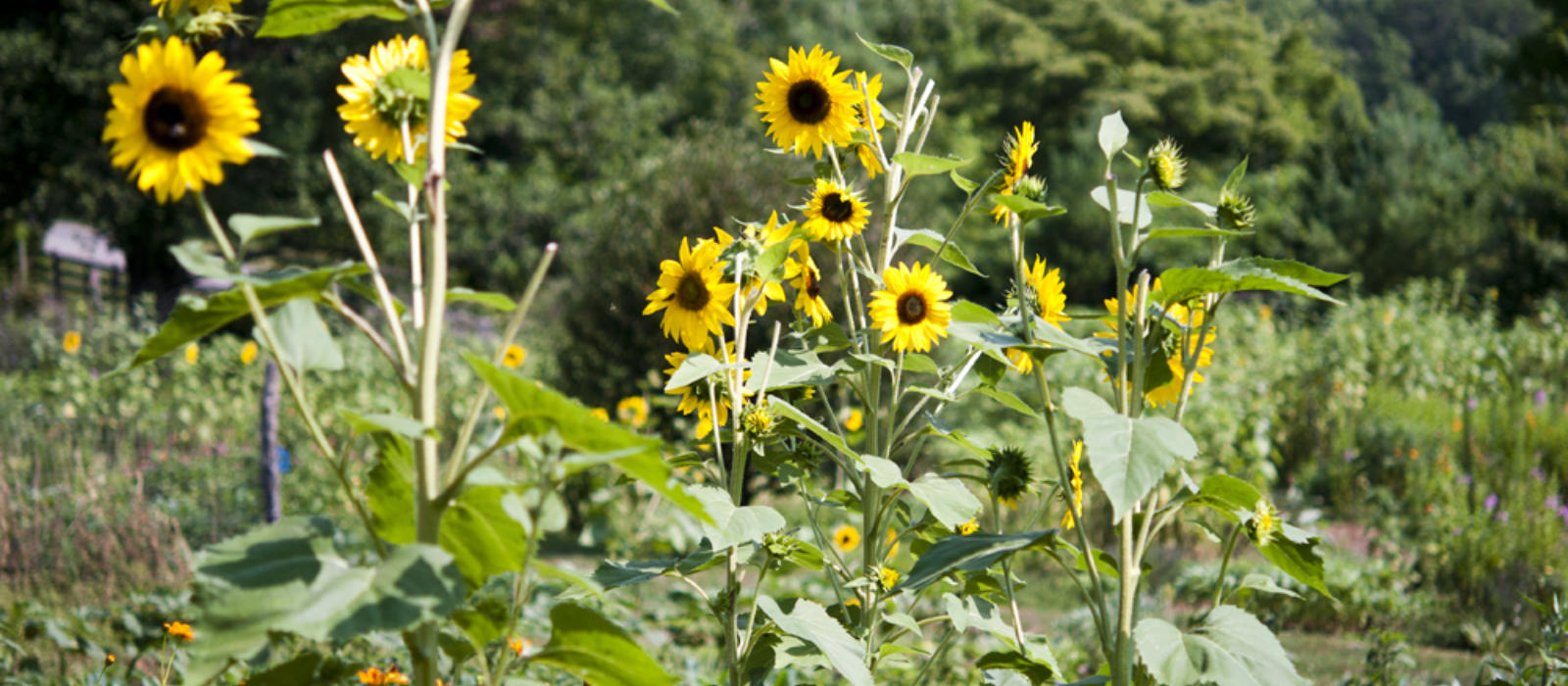
Native to North, Central and South America, sunflowers have been cultivated by native peoples for millennia. The first evidence of their growth in Tennessee dates back to 2500 B.C., in the days of the hunter-gatherer Cherokee and Creek peoples. Much later, visiting Spaniards introduced the plant to Europe, and dubbed it el girasol, which translates to “turns to the sun”. Sunflowers are heliotropic, which describes the way a young bud or blossom will rotate to face the sun as it tracks across the sky. Many ancient peoples, such as the Aztecs and Incas, widely used images of sunflowers in their worship of sun gods. We now continue to use the sunflower extensively in our culture; we grind the seeds for flour, press them for their oil and eat them roasted. Quite often, our culinary team here at Blackberry Farm will utilize immature seeds with their intricate, tiny flower parts still attached in their creations.
Sunflowers have many roles in the garden, too. As well as being stately and beautiful cut flowers, they attract a cadre of helpers to the garden. Birds in search of their seeds feast on a great many insects, pollinating butterflies and bees are attracted to the bright blooms and harmful insects like aphids and Japanese beetles flock to the leaves and stems and leave tender, emerging garden plants alone. In the fall, we cut the dried stems and attach the seed heads to a post or fence to feed the plethora of birds in the garden.
A close cousin to the statuesque sunflowers familiar to us is the Jerusalem artichoke. In a garden of immigrant vegetables and assimilated herbs, this plant is actually the only food crop indigenous to our area that is still rather commonly grown. The clusters of gilded blooms that open at the top of the towering stems resemble small sunflowers, while the tasty tubers underground offer a nutrition-packed ingredient for the fall menu. Early European explorers in the seventeenth century brought the odd nuggets back to Spain and Italy, then English speakers in the British Isles corrupted the name girasol or girasole into a Biblical reference they all knew – Jerusalem.Jeff Ross
Garden Manager
Native to North, Central and South America, sunflowers have been cultivated by native peoples for millennia. The first evidence of their growth in
Tennessee dates back to 2500 B.C., in the days of the hunter-gatherer Cherokee and Creek peoples. Much later, visiting Spaniards introduced the
plant to Europe, and dubbed it el girasol, which translates to “turns to the sun”. Sunflowers are heliotropic, which describes the way a young
bud or blossom will rotate to face the sun as it tracks across the sky. Many ancient peoples, such as the Aztecs and Incas, widely used images
of sunflowers in their worship of sun gods. We now continue to use the sunflower extensively in our culture; we grind the seeds for flour, press
them for their oil and eat them roasted. Quite often, our culinary team here at Blackberry Farm will utilize immature seeds with their intricate,
tiny flower parts still attached in their creations.
Sunflowers have many roles in the garden, too. As well as being stately and beautiful cut flowers, they attract a cadre of helpers to the garden. Birds in search of their seeds feast on a great many insects, pollinating butterflies and bees are attracted to the bright blooms and harmful insects like aphids and Japanese beetles flock to the leaves and stems and leave tender, emerging garden plants alone. In the fall, we cut the dried stems and attach the seed heads to a post or fence to feed the plethora of birds in the garden.
A close cousin to the statuesque sunflowers familiar to us is the Jerusalem artichoke. In a garden of immigrant vegetables and assimilated herbs, this plant is actually the only food crop indigenous to our area that is still rather commonly grown. The clusters of gilded blooms that open at the top of the towering stems resemble small sunflowers, while the tasty tubers underground offer a nutrition-packed ingredient for the fall menu. Early European explorers in the seventeenth century brought the odd nuggets back to Spain and Italy, then English speakers in the British Isles corrupted the name girasol or girasole into a Biblical reference they all knew – Jerusalem.
Jeff Ross
Garden Manager
Native to North, Central and South America, sunflowers have been cultivated by native peoples for millennia. The first evidence of their growth in Tennessee dates back to 2500 B.C., in the days of the hunter-gatherer Cherokee and Creek peoples. Much later, visiting Spaniards introduced the plant to Europe, and dubbed it el girasol, which translates to “turns to the sun”. Sunflowers are heliotropic, which describes the way a young bud or blossom will rotate to face the sun as it tracks across the sky. Many ancient peoples, such as the Aztecs and Incas, widely used images of sunflowers in their worship of sun gods. We now continue to use the sunflower extensively in our culture; we grind the seeds for flour, press them for their oil and eat them roasted. Quite often, our culinary team here at Blackberry Farm will utilize immature seeds with their intricate, tiny flower parts still attached in their creations.
Sunflowers have many roles in the garden, too. As well as being stately and beautiful cut flowers, they attract a cadre of helpers to the garden. Birds in search of their seeds feast on a great many insects, pollinating butterflies and bees are attracted to the bright blooms and harmful insects like aphids and Japanese beetles flock to the leaves and stems and leave tender, emerging garden plants alone. In the fall, we cut the dried stems and attach the seed heads to a post or fence to feed the plethora of birds in the garden.
A close cousin to the statuesque sunflowers familiar to us is the Jerusalem artichoke. In a garden of immigrant vegetables and assimilated herbs, this plant is actually the only food crop indigenous to our area that is still rather commonly grown. The clusters of gilded blooms that open at the top of the towering stems resemble small sunflowers, while the tasty tubers underground offer a nutrition-packed ingredient for the fall menu. Early European explorers in the seventeenth century brought the odd nuggets back to Spain and Italy, then English speakers in the British Isles corrupted the name girasol or girasole into a Biblical reference they all knew – Jerusalem.Jeff Ross
Garden Manager