
Story
An Annual Flight
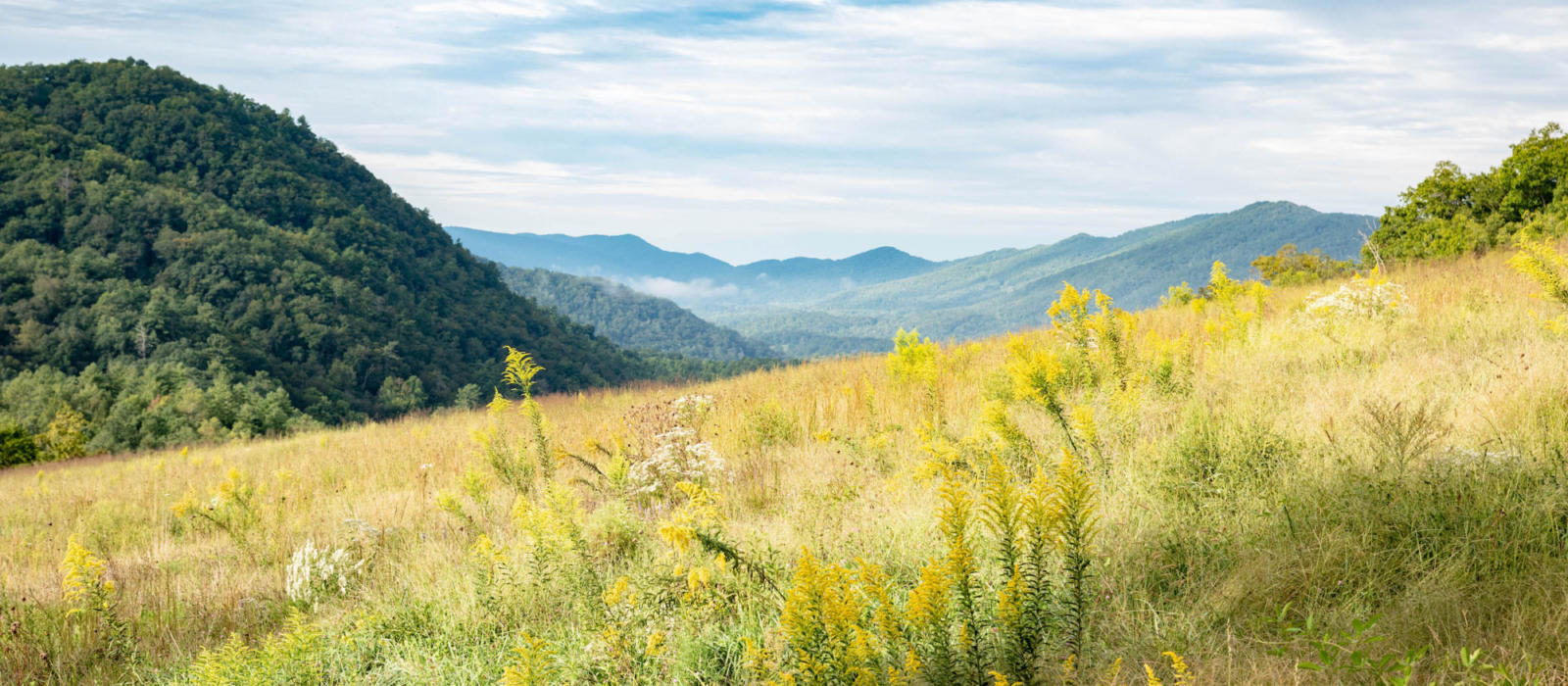
Every September, Chilhowee Mountain plays host to one of nature's most primal spectacles, as literally thousands of raptors (birds of prey) and Green Darners (dragon flies) glide above the Great Smoky Mountains and surrounding foothills on their way from Canada to the Gulf of Mexico and beyond. As many as 5,600 Broad-winged hawks have been known to cross Chilhowee Mountain in a single day in September, not to mention Bald and Golden eagles, Osprey and a parade of other raptors.
Often, while gazing at these magnificent birds through binoculars, one will catch a glimpse of their Harry Potter-esque, snitch-like traveling companions, the Green Darners – the sun glinting off of their neon blue and green armor and prismatic wings. When one considers their diminutive size compared to that of their avian counterparts, it is hard not to be impressed by the scope of the perilous 900-mile journey that they are on.
But why? Why here? Why cross the highest mountains east of the Mississippi River if you don't have to? Well, the truth is...they do have to!
This massive creature visitation is due to a fascinating phenomenon called "thermals.”
Thermals are rising columns of warm air that form when warm air and cool air collide. The warm air, being much less dense, rises above the cool air (updraft) as the heavier, cool air sinks beneath the warm air (downdraft). This is a dynamic phenomenon that shifts throughout the day. During the night and early morning, before the sun has unleashed its full strength, most of the air in and around the mountains is close to the same temperature; therefore, no thermals. As the day progresses and the sun bakes down on the southwest facing slopes, the warmed air begins to slide upwards.
Meanwhile, the ancient forests on the shadowed north-facing slopes cloister the previous night’s cool air within their twilight abbey's, releasing it ever so slowly. Like a whispered prayer of the trees, this tide of cool air rises gently to the top of Chilhowee where it is often felt by those who linger at the Firetower, but it can go no further. There it is, accosted by the stampeding warm air that gallops up from the rocky terrain of Goat Hill, the Rock House and Cat's Paw Ridge. Having collided with the cool, damp air from the Big Double, Cold Springs and Cowan Springs, this sultry ether is forced higher and higher, often over a mile into the azure sky.
Eventually it begins to cool and come back down, fueling the whole process all over again. The Broad-winged hawks ride these rising columns of air in spiraling flocks by the hundreds and thousands called "Kettles.” They will spend the night resting quietly in the trees. Once the thermals begin to rise in the late morning and early afternoon hours, they will spin up into the air like steam rising from a teapot or tea "kettle," often looking to all the world below like a great, slow tornado of birds. They continue to rise until the thermal tops out and then will effortlessly glide, gradually descending in the direction they want to go until being caught up by the next rising thermal and repeating the dance.
In this way, they are able to make their great journey while expending as little energy as necessary. This method of travel eliminates the need for distractions like detours and hunting forays and saves them a tremendous amount of time. Were it not for these thermals, it would be impossible for them to complete the trip on time. Traveling entirely under their own power, they would be overtaken by Winter and die of exposure, exhaustion and starvation before reaching their destination. Migrating birds returning across the vast expanse of the Gulf of Mexico will usually wait for the winds of a powerful storm to aid and carry them across for similar reasons. Perhaps the current storm in your own life is not meant for your harm, but is actually just helping you get to where you are meant to be.
Is Chilhowee Mountain special among so many mountains? Indeed, it is! While most mountains can assist in the formation of thermals, Chilhowee is unique in that it's southwest facing slope is long and fairly gentle, exposing massive acreage (about 2/3 of its 64,000 acres) to the warming kiss of the sun. Meanwhile, almost it's entire north-facing slope is what the old mountaineers referred to as "mule faced.” In other words, pretty much vertical and almost impossibly steep in places. What this means is that, below the dense canopy on the north face, there are cool, damp rocks and icy springs that seldom see the sun. It is a gigantic reservoir of cool air.
Coupled with its extensive intact forests, these vastly different aspects of Chilhowee make it a virtual thermal producing machine, as well as an ideal overnight rest stop for migratory raptors and tiny dragons.
What can we do to perpetuate this amazing annual occurrence and protect these priceless treasures that glide above us on the river of wind? I believe we are already on the right track. Between the Great Smoky Mountains National Park, Tennessee Wildlife Resources Agency, Foothills Land Conservancy, Hurricane Land Conservancy, and the visionary Beall family of Blackberry Farm and Blackberry Mountain, the bulk of Chilhowee Mountain is in conservation trust and being protected.
There are places here on the Mountain so ancient, so primal and undisturbed that to be present in them is a truly spiritual experience, never to be forgotten. Places so untouched and silent that one is loath to speak for fear of breaking the enchantment that hangs over them.
- Boyd Hopkins, Blackberry Mountain Head Naturalist