
Article
Unmeasured
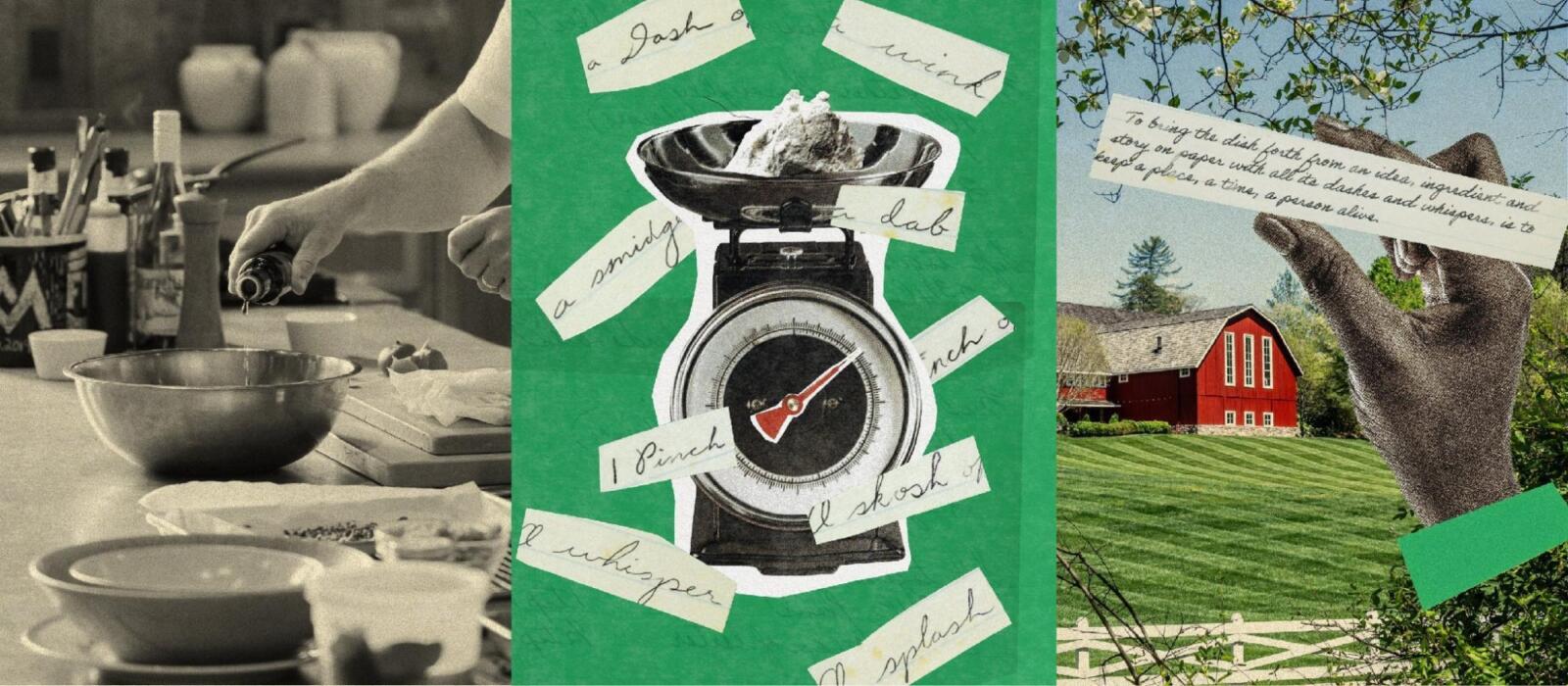
When I asked my dad how he and his sisters learned to make biscuits from my grandmother, he resorted to talking with his hands.
He held space between his thumb and pointer finger to demonstrate the size of an old-fashioned jelly jar with a pop-off lid. “It was about like that,” he said of his mother’s make-do measuring device. She kept the jar in a Hoosier bin with flour, which she bought by 25-pound sack. “I never heard any measurements in the kitchen,” he said. His sisters learned the recipes for chicken and dumplings, holiday dressing and chow chow relish, which they keep “up here,” Dad said, tapping his temple.
A few weeks later, I asked Mom about cooking and measurements on her side of the family. She pulled out a ragged copy of The Little Blue Cookbook, compiled in 1948 by the women of the First Methodist Church in Copperhill, Tennessee. The pages had splatters the color of milky coffee. We flipped to the Scalloped Tomatoes where measurements did exist – sort of. It called for a vague “can” of tomatoes with no specifics on size. Other ingredients would need “eyeballing,” like “butter, the size of an egg.”
Anyone who has cooked with old family recipes or passed-down favorites knows they can be as precise as a pinch and a dash. The details and measurements often lack fractions or weights. And yet, they still deliver in other kinds of exacting ways. Among their mysteries, they can unlock the specific scent of pie wafting from a windowsill in an aunt’s kitchen. They conjure a feeling or a story with church bell clarity. As mom looked at The Little Blue Cookbook, I watched pieces of life flash into focus. “Geniveue lived across from Roger and Carol’s Quick Burger,” she remembered looking at the woman’s cake recipe. “She was active in the garden club with Aunt Eunice.”
When I started to ask about favorite (and imprecise) recipe measurements from family, answers flooded in like casserole dishes to the potluck. Janelle likes the word “skosh.” Sarah’s grandmother used to say “about a mouthful.” Tony gets a kick out of “a breath,” and Suzanne likes “a whisper.” Sheri remembers hearing “an amount that will sit on a dime.” Pam is the fourth generation in her family to use a recipe for dressing, which calls for enough cornbread “to fill a cereal bowl.” Jaime likes the term “tinch,” while Bianca and Stephanie both like “tainch” (a cross between a tad and pinch).
My good friend Amanda Virgillito’s family uses the phrase, “und just a little.” The “und” stands for “and” in German, an homage to Amanda’s Oma who married her Opa, an American soldier in World War II. Oma Hildegard Liselotte learned to stretch meals in beautiful ways – pinto beans and dumplings, garlic noodles, soups and rye loaves with whipped butter and chives. Her recipes do list ingredients and measurements but no instructions. And while Amanda makes many of Oma’s dishes, like Gesundheits Kuchen, which translates to “bless you cake,” others have been harder to recreate.
“When you asked her how to make something, she would say ‘und just a little of this’,” Amanda said. So, when Amanda explained to her mother how a modern twist on a brownie with umami from soy sauce could taste good, she explained: “‘Und just a little.’ It’s something that just pops out in our language.”
As I spoke with folks about the meanings and translations for the vagaries on their recipe cards and community cookbooks, I started to understand that nobody really likes to be pressed too much on the specifics of measurements, but they do love to share the connecting threads that trace back to their people. There’s something spiritual, even, in the mystery of it. It can be mournful, too, similar to how grief over a loss of something – in this case, the special way someone made a dish – carries unexpressed gratitude. But to try to make these dishes with all their mysteries – to learn them, to practice their movements and eventually get them right by feel – is a way of saying “I know this person.”
It’s like we’re sharing the unspoken bond: “This is part of who I am. This is where and who I come from.” And to bring the dish forth from an idea, ingredient and story on paper with all its dashes and whispers, is to keep a place, a time, a person alive.