
Article
Uncharted
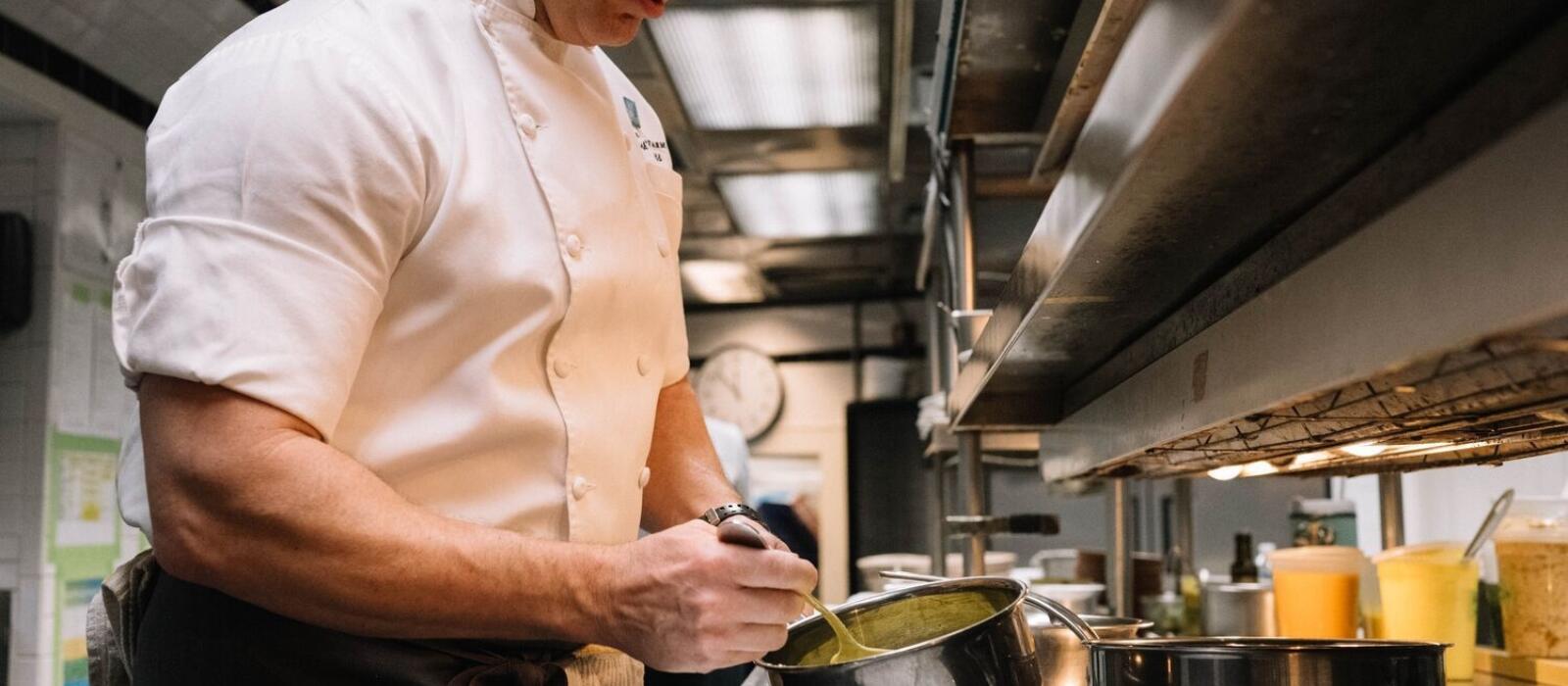
Josh Feathers will be the first to say he has “a little bit of an uncommon connection to food.” Growing up in East Tennessee, he didn’t stand at his grandmother’s elbow as she stirred simmering pots or rolled out biscuits. He didn’t concoct childhood cake-making experiments or spend days watching Food TV reruns. Rather, his learning began outdoors on the hunt for rabbit, quail, turkey and deer.
“I learned how to butcher and take care of the game,” says the avid sportsman. He recalls days coming home with a “mixed bag” when hunting was less segmented in its seasons. And his earliest memory of the hunt? “We ate a lot of squirrels,” he says. “We would quarter them up and then fry them down in almost like a braise situation.” After separating the meat from bone and adding flour and milk, he might spoon it over biscuits like a sausage gravy.
Josh comes from Bristol in the upper eastern corner of the state, known as the birthplace of country music and home to the famed stock-car race. While his culinary journey would eventually lead him to Blackberry Farm – just a couple hours down the road from his hometown – his path has been anything but conventional, with twists and turns that took him overseas from celebrated European culinary destinations to kitchens aboard yachts and inside the Pentagon.
“All of it has shaped me,” he says, “and got me to where I am today.”
Josh’s career initially began with disappointment. He joined the Navy after high school with a plan to serve as an air crew mechanic and search and rescue swimmer. A bout of anemia in basic training led to a reassignment: the kitchen.
“I was ready to be gung-ho, and do some wild stuff,” Josh said. “Being told I was going to be a cook was a little bit deflating. But I’ve always tried to see the best in things.”
He entered a training program of just about 10 weeks that introduced him to safe food-handling, more advanced kitchen skills and the Armed Forces Recipe Service: boxes of recipe cards with dishes scaled to 100 portions for multiplying to serve thousands. Josh took to it all naturally – a crash course for the military that might take years at traditional culinary school – and graduated first in his class. It meant he would have a top pick of destinations when his orders came down. Indeed, when his master chief delivered the news, he told Josh he had been trying for 25 years to get the assignment. Next stop: Naples, Italy.
“I had hardly ever been out of East Tennessee, except for maybe hunting trips to Alabama,” Josh said. So, after basic training in Orlando and cooking training in San Diego, he spent about two weeks at home before leaving for Italy at age 19. “Man, I was gone,” he said.” It was a situation where you leave home and come back a totally different person.”
Navy cooks hold a reputation as the most respected and skilled in the armed forces. (They staff the White House crew, for example.) And while some naval cooks might make meals for nearly 20,000 people aboard an aircraft carrier, Josh had the unique opportunity to hone his skills instead for 20 to 25 people in an admiral’s galley. After two years at the post, his commander recommended him for a job in the White House – an honor even to interview, though a bit too soon.
“I came home for four days,” he said. “And went back to Italy for another two years. I also came back married.” Josh met his wife Renae, who served with Army personnel on the NATO base where they both were stationed.
Then in 1997, he made the move to the secretary of the Navy mess hall at the Pentagon, where the restaurant serves many purposes. The day begins with breakfast and might include a bevy of reservations along with formal private lunch meetings – for example, for the chief of naval operations. Josh also worked with colleagues on catered events. “It was all good for helping me prepare for hotel cooking,” he said.
“The cool thing about my experience in the Navy that is missed in the culinary world: You do everything.” He prepared fi ne dining savory meals and made pastry, washed dishes, ordered supplies and kept up the pantry. The days also might include yacht cuisines down the Potomac River with three-course plated dinners for dignitaries.
This versatility and collection of skills suited Josh well as he made the transition from military to Blackberry Farm in 2000.
“We didn’t have a dedicated pastry chef here at that time,” Josh said. “Pastry was probably one of my stronger suits in the military. No one else wanted to do it.” So, he pitched in alongside Executive Chef John Fleer to help where needed and essentially worked as pastry chef for about 18 months before taking on the role of sous chef.
Over his multiple decades at Blackberry Farm, Josh has, of course, seen many shifts within the property too.
“There are so many stories I think about when Blackberry was growing and I was growing,” he says.
He helped open Blackberry Mountain in 2018 and returned to Blackberry Farm in 2020 where he now serves as executive chef at the Main House. He cooked alongside guest chefs Frank Stitt, Sean Brock, Daniel Humm and Tom Colicchio, and he even recalls with a chuckle the time Emeril Lagasse chastised him for not putting enough soup into a bowl. More poignantly, he remembers the influence and careful attention to detail of the late Sam Beall. “Those are all saved in the memory banks,” he said.
As he likes to say to colleagues, the lessons and practice and pursuit of excellence find their way into everything, from the finest dishes to grits at breakfast – all beginning with solid foundations built and practiced over a lifetime of rich and varied experience.
“Subconsciously, all these experiences are things I think about when I’m thinking about a dish,” he said. “There will always be foundations we start with that are never going to go away.”