
Article
A Perch from on High: The Millstone Gap Fire Tower
by Nadia Ramlagan October 27, 2019
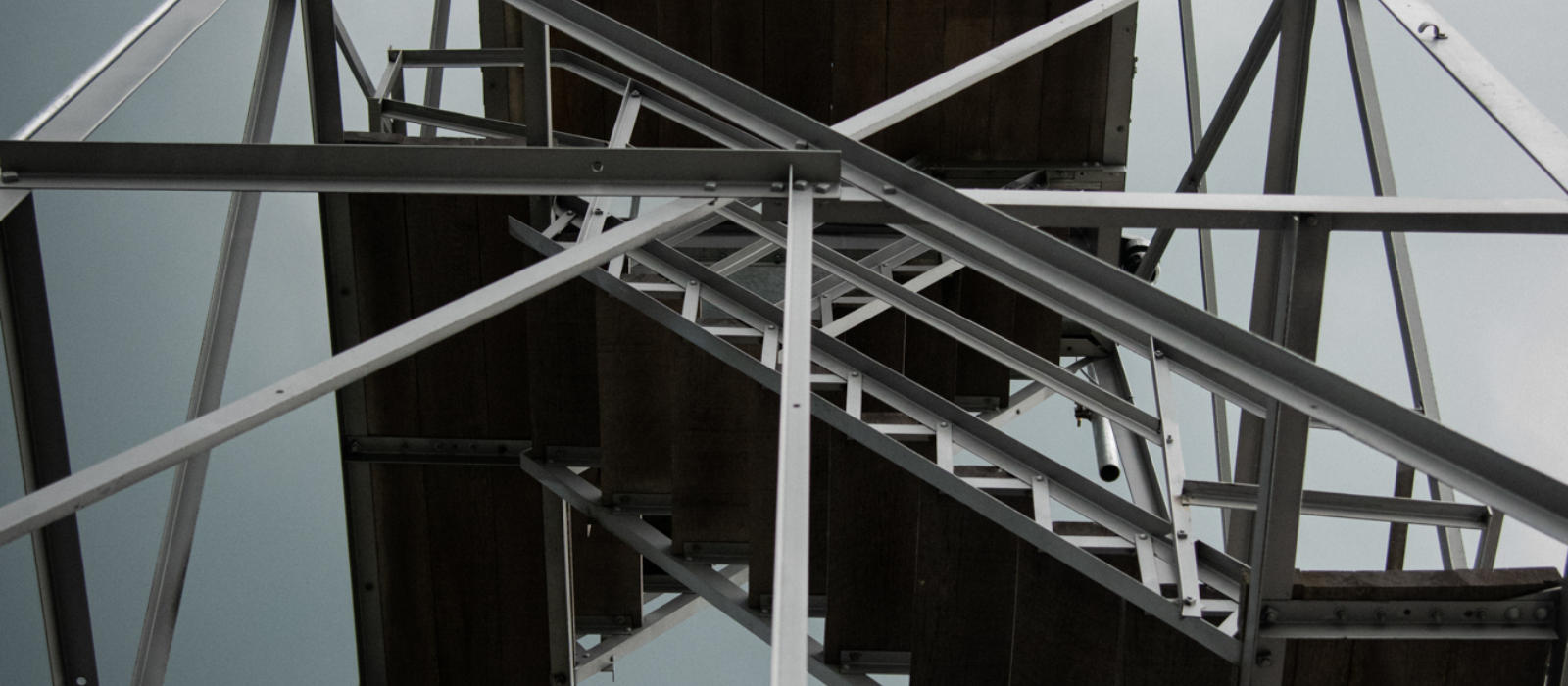
Fire towers are forgotten temples of forest conservation, isolated perches where the only thing a lookout relied on were his eyes and instinct. Most towers have met their fate as a heap of scrap metal, sold to make way for telecommunication towers, or abandoned as pilots took over fire watching. These fire lookout towers, or fire towers, were the cabins in the clouds, where men and women scanned the forest for drifting smoke or flames. Anchoring Blackberry Mountain’s Firetower restaurant, the Millstone Gap fire tower is a vestige of early twentieth-century techniques to put out wildfires before they could devour a landscape.
Parched conditions on the mountain in the 1940s had led to repeated spikes in fires. With the goal of protecting young-growth timber and the safety of tourists, the state’s forestry division came up with a forest fire plan in 1949 that included hiring mobile firefighting crews, building afire tower and hiring lookouts. On April 29 of that year, the Vestal Lumber company, which owned the land, deeded Millstone Gap to the state for the purpose of erecting a fire tower.Towers were typically built on peak elevation and were networked to ensure that vast areas of forest land came under the view of more than one tower. Using a blueprint and prefabricated parts, state forestry worker Howard Waters built the 47-foot-tall Millstone Gap fire tower in 1950. A crisscrossed steel frame supports a small square room at the top of the tower known as the cab, where wall-to-wall windows offer an unobstructed view of the mountains to the south and the tranquil valley to the north. Located on the mountain’s highest point, elevation 2,843 feet, the steel skyscraper rises above ridges and valleys. A lookout on duty had a panoramic view of the Great Smoky Mountains and East Tennessee.
State lookout towers were manned daily during fire seasons, generally in the fall, October through December, and in the spring, February through May. During these months, lookouts were paid to stay alert for long periods of time in solitude, scanning the horizon and warning dispatchers immediately at the sight of smoke. Fire personnel were rallied to put out flames at a moment’s notice, even during holidays. Howard’s uncle, known as Uncle Bud, worked as a lookout in the Millstone Gap fire tower. Howard’s son, Steve Waters, was tasked with fetching Uncle Bud drinking water. An old family friend named Milburn White also had a stint as a lookout, watching for fires in the tower. After school Steve would head up to Millstone Gap to keep Milburn company, often stopping on the way to pick wild huckleberries that he’d sell for two dollars a gallon. “We’d play all over this mountain when I was a child. Mother would throw some potatoes in a sack, hand it to us and tell us we had to be back by dinnertime,” Steve, now in his 70s, recalls.
Local residents took turns at the job of lookout, including at one point a husband and wife couple. A small house with a bed and wood stove near the base of the tower became a temporary home. Years after the tower was decommissioned, passerby hunters would stay in the lodging and warm themselves by the fire. Benson Spoon remembers walking up the mountain as a child and talking to the lookout on duty at the time. He’d camp there with other boys in the off-season.“We’d set up a tent on the tower steps because the snakes were so bad,” he says with a laugh.
Early fire towers were furnished with an oil heater, a triangulation map and a register book for recording names of visitors. Steve Waters remembers when a crank telephone was used by lookouts on duty in Millstone Gap. Later on, towers were equipped with binoculars, sun protection goggles and a two-way radio. From their perch in the tower’s cab, lookouts relied on a compass-like device mounted to a table to aid in pinpointing the location of a blaze, the direction of the wind, and to estimate the distance of flame and smoke from the tower. An instruction manual offered advice: When you see what appears to be a smoke, you must decide whether it is a false or real smoke. If you have any doubts about your decisions or what you have observed,report to your dispatcher immediately, giving him all the facts. Don’t take any chances.
When lightning storms hit, lookouts recorded every lightning strike they spotted. Dwight McCarter remembers fire watching during thunderstorms at Bunker Hill, a nearby fire tower in the Great Smoky Mountains National Park. The jolts of electricity made his hair stick straight up.Alone amid the chaos of thunder and the bright glare of lightning, he felt in awe of nature’s power. Some fire towers were equipped with glass-legged stools for lookouts to sit or stand on during storms, in case the tower was struck.
Nearly seven decades later, the Millstone Gap tower has few signs of wear and tear, according to a restoration expert who visited the property. Steel fire towers in the Great Smoky Mountains do not corrode as quickly as fire towers in other parts of the country, mainly because the air in the region is cleaner. Yet of the 250 towers erected in Tennessee, most have vanished. Those still looming over far-flung mountaintops are, as one state forester put it, in limbo, either left to disrepair or vandalism. Both design inspiration and tribute to the legacy of early conservation efforts, the Millstone Gap fire tower is likely the first in the country whose architecture has been preserved and woven into a dining space. Blackberry Mountain visitors can get a feel for what it must have been like to train one’s eyes on the landscape for hours on end, mountain ridges against a never-ending sky, a view unchanged from what a lookout on duty must have experienced, as he climbed the tower every morning to sit and keep watch from dawn to dusk. In a new era of land preservation, the Millstone Gap fire tower remains a sentinel of the forest.