
Article
The Light Around the World
A 23.5-degree tilt of the earth’s axis is the difference between the richly colored canvases of Paul Gauguin and the dusty pastels of the Danish painter Vilhelm Hammershøi. The former is famous for his impressionist portrayals of life in tropical French Polynesia, with punches of deep reds and earthy oranges against patches of lush greens and golden yellows. The latter is most well known for his quiet, empty, interior scenes in muted greyscale. Hammershøi’s home in Copenhagen, it seems, was perpetually in the final moments of dusk.
These are not just stylistic differences. They reflect something fundamental about place and time. Gauguin was painting just 17 degrees south of the equator in the middle of the Pacific Ocean, where the earth receives the brunt of the sun’s hot, blazing rays. It’s no coincidence that tropical prints tend to be bold and vivid. The abundant sunshine not only breeds a more diverse and colorful palette of flora and fauna, but the direct overhead light reduces reality into geometric blocks of simple colors – much the way Gauguin described it with his brush.
At nearly 56 degrees north – closer to the top of our planet than the equator – Hammershøi experienced light very differently. Perched high on our spinning sphere, he watched the sun scrape the horizon for most of the year, fracturing light and thus casting soft, long shadows. For anyone who has spent time in Scandinavia, Hammershøi’s moody paintings faithfully capture this velvety reality.
As a photographer, I’m keenly aware that the position of the sun, and my proximity to it, not only dictates the colors I see, but how I see them. For example, at higher altitudes, the world looks bluer. Of course, there is science behind this: The higher up you go, the thinner air becomes, and thus, there are fewer air molecules by which light can be scattered. Blue light, having shorter wavelengths, scatters more efficiently in thin air than warmer colors, which have longer wavelengths.
This is noticeable at Blackberry Mountain, where the light tends to be colder – especially on clear, bright days – than in the valley below, where Blackberry Farm is nestled among the foothills of the Great Smoky Mountains. Having photographed both properties throughout the calendar, I’ve been able to observe the light in those Appalachian hills closely.
Located somewhere between Gauguin and Hammershøi at nearly 36 degrees north, Walland, Tennessee, shares roughly the same latitude on the earth’s rotation as Gibraltar, Crete and Tokyo. Although the sun’s position in the sky might be similar year-round in those places, the light is different in each. Walland is not adrift on a giant Mediterranean mirror, like Gibraltar and Crete, or on a flat, open plain encircled by volcanic mountains like Tokyo.
Winter days in Walland are short and often overcast. Shorn of its green canopy, the hills are bare. The light is dull and chalky, making the warm, flickering glow of the fireplace an especially attractive subject. When the sun is out, it’s lower in the sky, shining a crisp, clean light that creates lingering shadows and the kind of moodiness that Hammershøi captured in his mesmerizing interior scenes.
By contrast, the intense, direct, overhead light of the summer sun is akin to what Gauguin experienced – a bulldozer that flattens both dimension and color. It might be tempting to think that a sunny day is a boon for a photographer. I think it poses more challenges than advantages.
When the days grow long in Tennessee, taking pictures at dawn or dusk is my trusty antidote to the blinding bleach of the noonday sun. Like most photographers, I find light to be far more dynamic on the edge of day anyway. In those fringe hours, it diffuses into a million grades, enriching textures and deepening color. In those shaping shadows, mystery hangs in the air and possibility is afoot.
The drama is magnified in those eastern hollows, where dawn is presaged from behind the mountains and the afterlight persists when the sun drops behind the range.
In the early morning, everything is dyed an inky blue, pulling greens and reds in its direction.
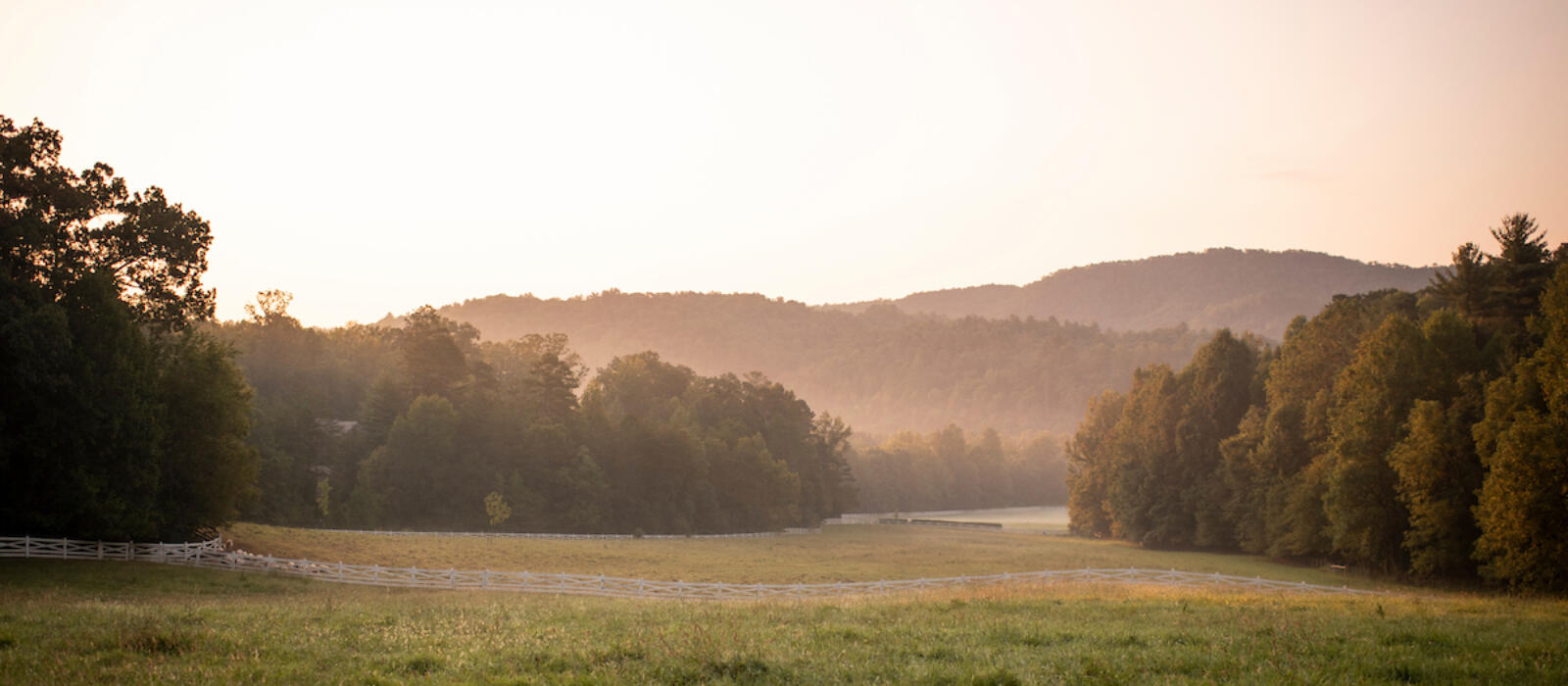
Fog lingers low and long, becoming a nebular glowbox of warm, peachy radiance as it lifts to make way for day. Many are the mornings when I’ve watched this transition take place across that dew-kissed field lined with miles of white fencing or from the veranda at the Main House.
The process reverses at dusk, when a cotton candy sky is set alight, a brief bonfire in the heavens that quickly becomes the dimming embers of nightfall. In those twilight moments, the sedation of inky-blue returns, as beautifully captured by John Singer Sargent with near-mystical accuracy in “Carnation, Lily, Lily, Rose” (1885–86).
It is a bewitching hour when neither eye nor camera comprehends color, as dashes of fireflies add to the delirium. Simply stated, it’s magical.
The expressive skies over the English countryside so poetically painted by John Constable are different from the pastel grandeur Canaletto depicts above Venice, or the hazy periwinkles and turquoises in Frederic Remington’s dusty “Westernscapes.” These paintings are convincing representations of reality because they are studied notes on nature. The hue of the clouds, the placement of the sun, the way a shaft of light hits or how a shadow falls – these are all cues and clues to a specific time and place, just as much as any cathedral, canal or cactus.
Whether we’re aware of it or not, we are constantly recording these subtle details. They help familiarize us with the world around us and orient ourselves within it. Look up. Look down. Look all around. Wherever you are, there’s no place else in the world like it.