
Article
Temperature of Creation
photo by Ford Yates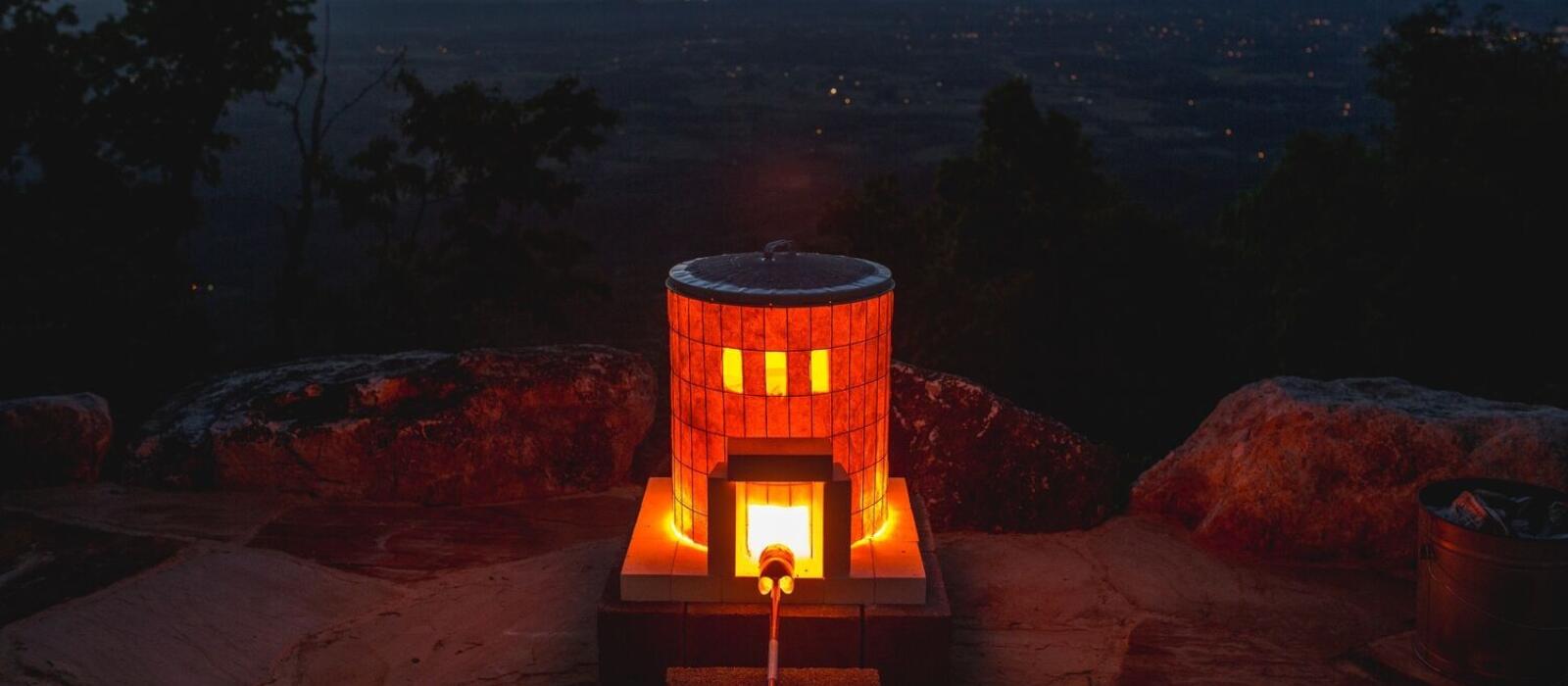
“There’d be no ceramics without heat,” says artist Keith Kreeger. Keith has been working with clay for the last 26 years, ever since he took a summer course at Skidmore College and fell in love with the process. After working at a co-op studio in Port Chester, New York, and starting his own studio in Cape Cod, Keith relocated to Austin, Texas, where he now lives and works.
Keith walks me through his ceramics practice, explaining how temperature plays an integral role in transforming clay into a functional object. To date, his work has been focused primarily on the pieces we use around a table: serving bowls, vases, pitchers, mugs. He’s become known for his dinnerware, working with chefs around the country to make custom sets. To him, the appeal of dinnerware comes down to connection and community. “Ceramics has a very long history for human beings, and it started as a way to store, cook and serve food. You needed all of these functional objects to live.”
While these objects may not be strictly necessary today, he says, the rituals behind them remain. “It’s one of the few pieces of art that you touch and hold. If it’s a cup, you’re bringing it to your lips,” Keith says. “When I’m making something, I’m thinking about how it’s going to be held, how it’s going to be passed across the table, how it’s going to feel in your hand.”
Clay itself is broken down rock that has been eroded over time along riverbeds, picking up impurities along the way. (That’s what gives different clays different properties.) Using time and temperature, Keith says, “I’m bringing it as close back to rock as we can.”
His process begins with 50-pound boxes of commercially mixed clay, which he receives one ton at a time. He preps the clay, wedging it and weighing it out before hand-throwing on the wheel or using a jigger machine that compresses the clay into an already-made mold, mimicking the throwing process. He’ll dry his pieces overnight and then decorate them while the clay is still somewhat soft.
Before the first firing, for example, the clay has the most amount of water in it – that’s what makes it moldable. “It's my favorite part of the process. The clay has life to it, it glistens. It’s got fresh movement to it.” After drying for one more week, the pieces go into the kiln for the first firing, also called the “bisque firing,” at 1,800 degrees Fahrenheit. “That’s the first time there’s a chemical change in the clay. So, the clay lasts forever at that point,” he says. It’s still porous enough, though, that when glazed, the clay will soak in some of the moisture of the glaze and the color will sit on the surface. After glazing, the clay goes back into the kiln at 2,300 degrees, a process that usually takes 10 hours, before cooling for a day and a half.
“It’s a work-heat relationship,” Keith explains of the process that brings clay to maturity. “The faster you fire, the lower the temperature has to be.” Keith uses a high-fire clay body, but if he were to use earthenware in the same way, it would melt into a puddle on the floor of the kiln.
Keith uses electric fired kilns, the same kind used at Blackberry Mountain for pieces made by guests. “My kilns are basically giant toaster ovens. They have a little computer control panel, and I’ll type in the temperature that I want it to go to and the rate of temperature rise.” This is an important step, as sometimes he’ll need to ease through certain temperatures; other times, he’ll want to speed through.
At the start of the bisque firing, Keith says, “I have to worry about water boiling – even though it’s dry to the touch. I’ll usually hold it at 200 degrees for a little while, and I’ll go slowly through the boiling point. Then, I can speed back up.” At around 800 degrees, some more water is released, and at 1,063 degrees, quartz inversion happens. “On the way up, the silica in the clay is going to expand, and on the way down, it’s going to contract. You want to be slow as you’re going through that temperature.”
Of course, when playing with such extreme temperatures, things can go wrong. Bits from the kiln can fall into a piece, foot rings can stick to the shelves of the kiln, and cracks can form during the cooling process. “There are lots of ways to be disappointed with clay,” Keith says. If it doesn’t reach temperature the first time, he can save pieces with a second, or a third, firing. But, he says, “you can’t save something that got too hot.”
When it comes to adding heat to ceramics, electric kilns aren’t the only option. A gas kiln allows you to deprive the flame of oxygen, which changes, for example, the chemical components of iron-bearing dark clay bodies. This results in a uniquely green porcelain color. In a soda kiln, you add sodium bicarbonate (baking soda), which ends up vaporizing, leaving the sodium to bond with the clay itself, affecting the glaze. You can also fire with wood, whose ash become a glaze unto itself.
And then there are practices like raku firing, a post-secondary reduction firing process based off of an ancient Japanese technique. During a Blackberry Mountain raku class, guests are invited to participate in the firing process itself. “Our collaboration begins when the guests arrive and choose one of the cylinders that we’ve wheel-thrown,” says Polly Ann Martin, who runs the art studio at Blackberry Mountain. In just a few hours, they’ll glaze and fire their own pieces. As soon as the kiln reaches temperature (1,850 degrees), guests take the work out and put it into a combustible chamber. Shortly after, they walk away with a finished piece that contains a unique glaze.
Polly Ann lives and breathes pottery. She has taught at places like Rhode Island School of Design and New York’s 92nd Street Y over the years, and ended up in Knoxville after her husband was offered a position in the art and architecture department at the University of Tennessee. Ultimately, she began working at Blackberry Farm and, when it opened four years ago, spearheaded the art program at Blackberry Mountain. After decades of teaching, the appeal remains the same: an opportunity to exchange ideas. “There are a lot of people that come from different walks of life,” she says. “There’s an earnest opportunity to expose someone to a medium that they’ve never tried before and learn something new.”
Aside from raku, Polly Ann’s program offers wheel throwing, hand building and tile making classes, all using white clays that fire at mid-range temperatures. This type of clay “genuinely celebrates the culinary arts, which is the main focus in terms of Blackberry itself,” Polly Ann says. Whether you’re making a vase for the first time or, in Keith’s case, the hundredth time, the idea is the same – to create a piece of art that you can use. It helps that clay as material is uniquely insulating. A clay mug will hold coffee warmer than a glass one, and a chilled plate will keep salad cool and crisp. “Ceramic tiles were even used on the bottom of the space shuttle because of their insulating capabilities,” Keith shares.
When it comes to working with clay, both Keith and Polly Ann are continually amazed by the process. “You are starting with the humble beginnings of earth itself,” Polly Ann says. “The fact that you can take a common earth material, transform it chemically into a vitrified material, apply other materials like silica or quartz on the surface to vitrify it at an even higher temperature … and then be able to use those objects functionally is really quite astonishing. Just to be a part of that transformation is amazing.”