
Article
Razzle Dazzle
Like me, I’m sure many of you have approached eye-watering nirvana under the influence of a smidge too much wasabi.
Those of us who like a bit (or a lot) of kick know that spicy heat comes in many forms. The radish family, to which wasabi belongs, for example, offers everything from the sweet bite of those cute, French breakfast rubies to the sinus-clearing, nuclear-grade varieties of the horsey kind.
We’re all familiar with the prickly heat of peppercorns (which are actually berries from a flowering vine). When dried, the pepper berries turn black and have that wild, untamed crack we know so well. I prefer white peppercorns, which are dried berries with the skins removed. These have a softer, muskier – and I would say, sneezier – spice about them. Used throughout Chinese cooking, white pepper is incredibly nostalgic for me. It’s the invisible heat in hot and sour soup, and one half of the yin-yang that makes salt and pepper dishes so tasty.
But peppercorns can be quite mild, as well, like the pink ones, which are incredibly fragrant and floral, or the green ones, which are often brined and pickled. Like tiny capers with just a bit more personality, green peppercorns contribute the pep and poivre to steak au poivre.
Wholly unrelated are Szechuan peppercorns, which trigger a strange tingling sensation. The Chinese call it ma la, or “numbing heat.” In Szechuan cooking, these peppercorns are often paired with chile peppers to unleash a torrent of spiciness that, to the uninitiated, can strip your face of all feeling and flavor for quite some time.
Of course, the most popular source of spicy heat is the incredibly diverse chile pepper family. Chiles come in just as many colors and express as many different types of spiciness as there are varieties, numbering in the thousands. Jalapeños and cayenne peppers, for example, deliver a quick, sharp sting, whereas some, like serrano or Fresno, offer a warm, steady glow. At the higher end of the Scoville scale – a system used to measure the concentration of capsaicin, the chemical culprit that makes chiles spicy – are the peppers that slowly bloom, sometimes into a raging inferno, eliciting a delayed surprise and often regret. By the time you realize you should stop, you’ve already ventured much further than you ought.
But there is something cathartic in the pain. No matter how many times we’ve been burned, we go back to the salsa, the chili crunch, the Tabasco and sriracha. That’s because, in the right amount, spiciness can be incredibly flavorful. This is especially true when it’s paired with fat, a particularly effective megaphone for proselytizing the gospel of heat. Mother Nature is wonderfully instructive in this regard – capsaicin appears naturally in chiles as an oil compound, which helps explain why it spreads and coats so readily. This also explains why beer goes so well with hot wings or coconut milk is such a good companion to curry. The fiery properties of chile peppers, being naturally water repellent, are best countered with alcohol and fat.
Mother Nature is clever in another way, too. Chile peppers thrive in hot weather, where a good sweat from a spicy bowl of tom yum soup or a heady vindaloo is a natural and therapeutic way of cooling down. The astronomer Galileo Galilei once poetically described wine as “sunlight, held together by water.” The same might be said of chiles, capturing and refracting the sun’s warm rays onto everything from tacos to deviled eggs.
Unsurprisingly, chefs love spicing things up. Spicy ingredients are dynamic and powerful, and precisely because they are, using them can be challenging – you want jazz hands in your bucatini, but not a rear hook to the jaw.
I asked Joel Werner, the executive chef of the Firetower at Blackberry Mountain, to explain his approach. Having loved hot sauces all his life, he decided to try to make his own. It started as a side project when he was a cook at The Barn at Blackberry Farm®.
Joel played around with fermenting assorted chiles, including Fresno, jalapeño and Aleppo, many from the vegetable farm just yards from the restaurant. In addition to those fresh peppers, his recipe also included sweet onion, garlic and salt. All this was mashed together to form a paste, which he fermented for about a week, ideally in warm, open air.
The fermentation process intensifies the flavors of the paste, which is thinned out with vinegar afterward. Not only is the high acidity of vinegar a natural preservative, but, together with the spiciness of the chiles, it helps to cut through the fatty foods that pair well with it. The surprising part to me is that Joel also added a touch of honey to help balance out the flavor and the consistency of the sauce. It took years of tinkering to get everything just right – something with just enough zing to make you want more. What he ended up with was two different hot sauces – one green, one red.
When Joel was promoted to executive chef of the Firetower, his side project found a home on a menu. He says his spicy condiments were easy allies of his style of cooking. His simple egg dishes benefited from the high tang of the green hot sauce, and the flavor of hearty meats deepened with the warm glow of red chili spice.
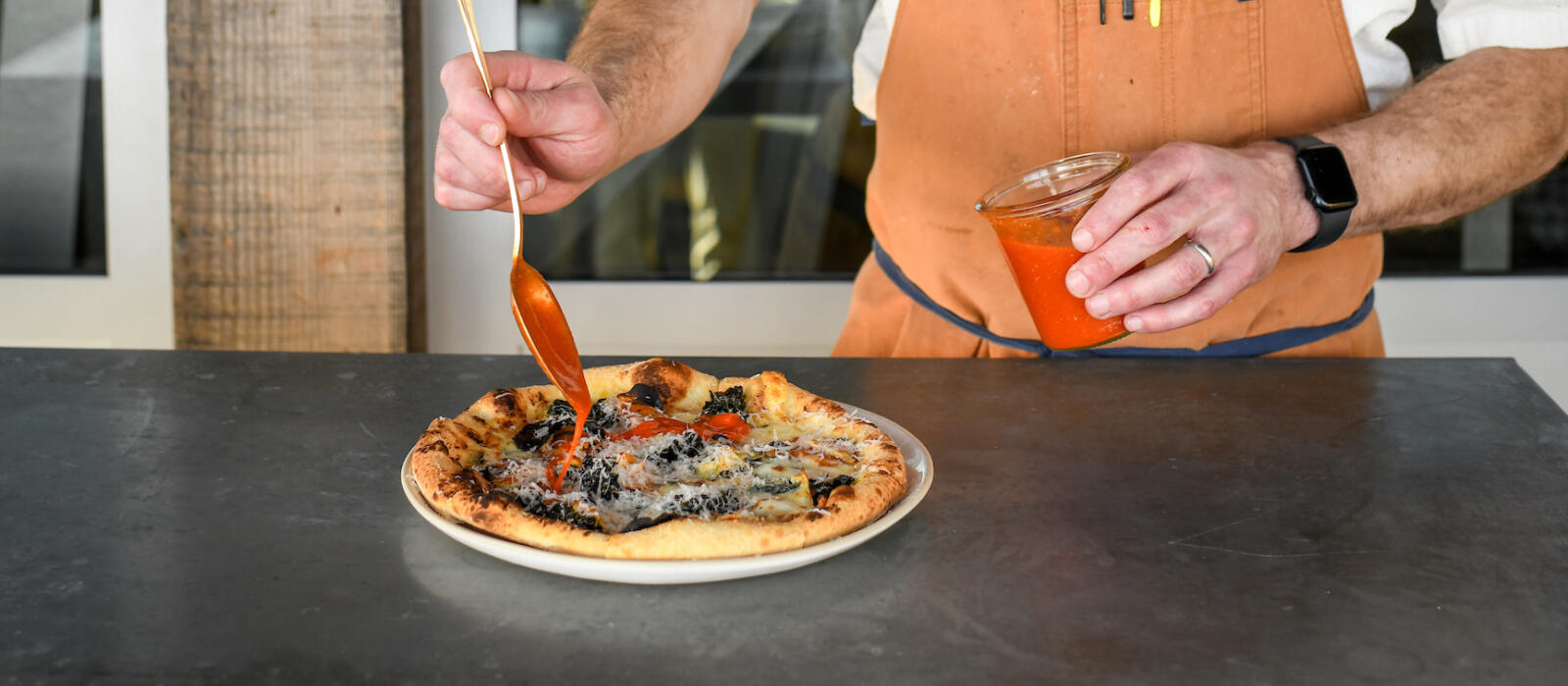
Perhaps his favorite way to use and serve hot sauce is with pizza, which has appeared on his menu from time to time. In fact, his red sauce debuted at the Firetower alongside a white pizza topped with sweet potatoes and kale. He especially likes the brightness of the sauce against the bitter greens. Taking on a double duty, Joel’s now-branded Firetower Hot Sauce not only took the place of chili flakes – a familiar and favored pizza seasoning – but its tartness also stood in well for the tomato sauce on which pizzas usually rely for tanginess.
I’ve had many of those knobby-crusted pies sitting on the deck at the Firetower at Blackberry Mountain, usually on the kind of clear, bright summer days best for growing chiles. I love having the warm, midday sun on my back while having it radiated back to me from a dash of Joel’s fermented chiles. Like the best kind of spiciness, it’s a little razzle dazzle, a high-kick at noon.