
Article
Known By Name
photo by Sarah Rau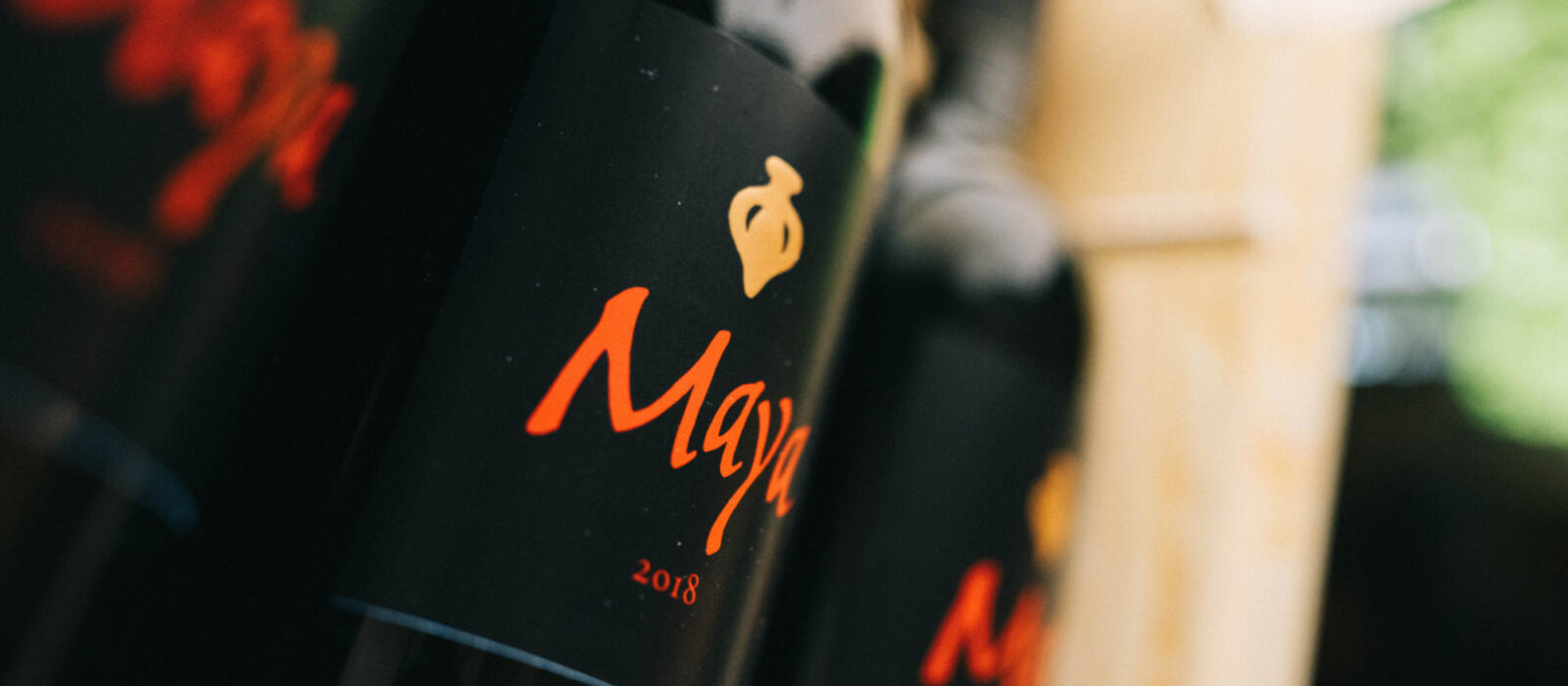
When Gustav and Naoko Dalla Valle planted a 20-acre hillside vineyard in Oakville on Napa Valley’s eastern slope in 1987, there was one parcel that stood out for its red, iron-rich, rocky, clay soil. That very same year, their daughter was born. Both the vineyard block and the baby were given the name Maya. In 1988, they bottled their first vintage blend of cabernet sauvignon and cabernet franc from that one block on their 20- acre property. That wine is also called Maya.
“As soon as I could read, I remember seeing all the boxes of wine with my name on them and saying to my parents, ‘These are all my wines. You can’t sell them. They’re mine,’” says Maya Dalla Valle. “And they were like, ‘Let’s be clear about one thing: We named this wine after you because we love you very much, but this is not your wine,’” laughs Maya.
Today, her connection to the wine goes far beyond the name on case boxes or labels. Since 2021, Maya is also the winemaker of Dalla Valle’s Maya. She’s a member of a small group of winemakers, mostly women, around the world who are now making or running the wineries that turn out their namesake bottles.
“In general, I hate the spotlight and being the center of attention, so it cannot have happened to a worse person,” says Maya, joking that she’ll need to have a daughter and name her Maya so that she can take the heat off herself a bit.
The nature of wine is such that sommeliers and wine writers are constantly looking to assign words that are usually meant for people to it. Thankfully, however slowly, we’re moving past “feminine” or “masculine” as descriptors, but human characteristics of generosity, power, persistence, elegance and shyness are so often ascribed to these liquids.
Once a person’s name shows up on a label, it’s only a matter of time before questions of commonality start to bubble up.
Maya, the vineyard, is one that Maya, the person, describes as being very self-sufficient, with vines that have deep-set roots, and is often the last on the property to need irrigation. Since she came on as director of Dalla Valle in 2017, the vineyards have been converted to biodynamic farming. As for the wine, she’s upped the percentage of cabernet franc in the blend and is using some amphorae in the cellar for aging. “I always say it’s like a very philosophical wine,” she says. “It keeps pulling you to the glass; each time you smell it or taste it, there’s a different element that you get a glimpse of, but it doesn’t fully reveal itself.”
Over in the Rhône, winemaker Laurence Féraud of the famed Domaine du Pégau is the caretaker of a wine named in her honor, a Châteauneuf-du-Pape. Her father, Paul, called one of his wines Cuvée Laurence, in a spur-of-the-moment decision in 1997, when bottling some wines that had been languishing in barrels in his cellar for over a decade.
As she tells it, she was an adult and working alongside him at Pégau when he sort of blurted out the name in a pinch and it stuck. Pégau produces a few reserve wines, one of which is Cuvée Laurence, which is only made in certain years. It’s a rendition of the winery’s Cuvée Reservée, which is aged for two years in large old barrels – the Férauds hold back 10% of the Reservée and age that wine two years longer, which is then released under her name. “Cuvée Laurence is more approachable, more integrated,” Laurence says. “Because it’s more mature, it has a softer tannin and more spice.”
Now in his eighties, Paul still has a hand in the winery and Laurence has stuck to his techniques, which were passed down to him by his mother, trusting in the legacy of good winemaking. Laurence’s children, Maxime and Justine, both had wines named for them in the years they were born – but for one vintage only. Instead of that lineage, she’s given them a winery – separate from Pégau, but also in Châteauneuf-du-Pape, called Domaine Porte Rouge. “Three generations was too much,” she laughs. “I gave them the opportunity to experiment with everything they want on those four hectares,” she says.
So much in wine has a feeling of permanence – much in the way that a person’s name does. A vineyard will grow and evolve over the course of years, but it takes so long for a vine to root down and establish itself, to really start to settle in.
The question of whether a wine can define a person or a person a wine is one that Chloé Asseo Fabre, now the general manager of her family’s L’Aventure Winery in California’s Paso Robles, has been grappling with when considering the wine that her father, Stephan, named Chloé in 2010. “So, I guess my dad always wanted to make a wine for me. He was waiting for the right occasion where the personality of the wine reminded him of my personality.” He found it in a north-facing block of Syrah with a few rows of adjacent grenache that he fermented together, resulting in a wine that was spicy, with a lot of character and complexity to the wine, but still young. She was 20 when the wine was first made. “In the past two or three years, the wine has gotten to be a pretty big, beast of a wine,” she says. “My dad realized that it may be time to soften the Chloé a bit to keep it in line with how I’m evolving.” Stephan’s added more white grapes to the blend to try to keep it more in line with his daughter, “in his own love language of wine,” she says. And whether the wines bring out mirrors or not, the essence of their existence is one that is felt by all of these women.
“There’s definitely a greater sense of responsibility when your wine has your first and last name on it – and your mom is your boss. It’s so multilayered,” Maya says. “But in a more emotional, sentimental sense, it’s really sweet to think about this wine that my parents were nice enough to name after me and make the top tier wine – and how far it’s taken us.”
Click to read more from the full digital release of Blackberry Magazine, The Muse Issue.