
Article
Double Dutch
photos by Bonjwing Lee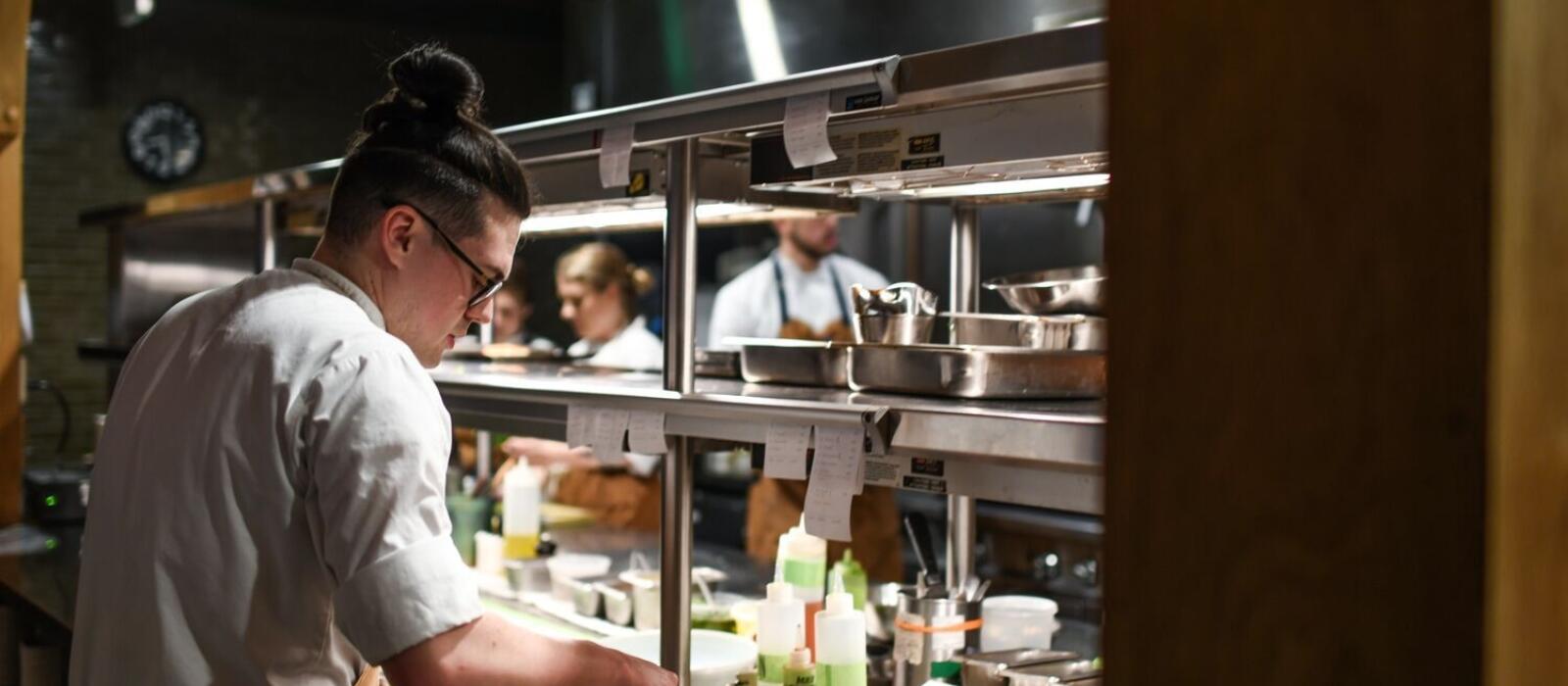
Bonjwing Lee is a professional photographer with years of experience photographing food and chefs, in and out of the kitchen. Bonjwing has photographed for Blackberry Farm, Blackberry Mountain and restaurants all around the world, meticulously working to capture the shot while never interrupting the unique flow of the kitchen.
In the crush of service, the professional kitchen can be a minefield.
There are sharp objects and sharp edges, and hot pans shuttling to and fro. Tongs clap at hot coals, sparks fly off the grill, and there are the occasional flare-ups, flameouts and oil spatters. Miraculously, amid all the chaos, servers juggle plates and stemware while scurrying across slippery floors.
At its best, what we in the industry call the “back of the house” is a choreographed dance. But as anyone who has worked in a restaurant knows, if the wrong piece is pulled out of the stack at the wrong time, things come apart quickly, and often disastrously.
Speed and accuracy are paramount. But, achieving one without the other is useless. It’s not just about getting a soufflé to the table before it deflates, but efficiency determines a restaurant’s overall viability.
The stakes were highlighted to me many years ago, when I had the opportunity to dine at the restaurant El Bulli on the Costa Brava of Spain. Celebrated as the high temple of modernist cooking – a culinary movement that was all the rage in late 1990s and early 2000s – the restaurant was widely regarded as the ne plus ultra of destination dining, with a waitlist to match: El Bulli received over a million requests each year for a few thousand seats.
Both of my meals at El Bulli featured over 40 courses. When I marveled out loud at how quickly dishes appeared and disappeared – like at Hartsfield-Jackson airport, one landed just as one took off – I was quickly alerted to simple math. If each dish was late by just one minute, that would add nearly an hour to our meal, which, in turn, would add an hour to the staff’s workday. It was imperative that every dish came off the line correctly the first time, and on time.
Of course, El Bulli was exceptional, not only because of the staggering number of courses it managed to produce, but also because it ran only one service each day (either lunch or dinner – not both), and it didn’t turn its tables – that is, there was only one reservation per table per service. At most restaurants, which need to turnover multiple times through multiple services to be profitable, the margin for error is even narrower. The smallest delays are untenable.
As a professional photographer, I’ve had a front row seat to some of the world’s most acclaimed kitchens, ones with incredible discipline and accuracy, and as a result, often incredible history too. These are fast-paced and demanding environments, usually packed into extremely tight quarters. Having documented them for over a decade, I’ve become acutely aware of just how superfluous – and, to be frank, annoying – my presence is. When things are full tilt, the last thing a line cook needs is another body in the way, especially one that isn’t contributing to efficiency. Of all of the people in the kitchen, I cannot be the one that causes trouble.
To the uninitiated, navigating a working kitchen like this can be terrifying. But, if the kitchen is well-run and organized, and you’re observant, patterns emerge that help you sync and move with the crew.
The primary goal is to be out of the way. In a small kitchen, that can be difficult, sometimes impossible. I’ve learned to hug the edges, leaving open spaces clear for through traffic. You’ll usually find me along the perimeter of the kitchen, with my back to the wall. From there, I can usually survey multiple stations and visually learn the various cooking and plating processes at each one. I will watch them from beginning to end repeatedly, mentally clocking the timing of every step.
Not unlike learning an obstacle course, knowing when and where a cook is likely to move and not move, and which drawers and doors need to be left accessible, helps me determine the least disruptive path and position to take, while still getting the shots I want.
When I’m ready, I get in and out as quickly as possible, tracing the counters as I go. The worst place to stand is always behind a cook because they can’t see me – and that space is usually a high-traffic lane anyway. The best place is usually across the counter from them. But that vantage rarely exists, as narrow galleys and small spaces usually require counters to be up against the walls.
So, often, the only place to stand happens to also be one of the least intrusive: next to a cook. Side by side, both of us are aware of each other’s presence. Having studied their routine helps me to anticipate and move with them. This is especially important when I disappear into the tunnel of my camera’s viewfinder.
There’s also an ebb and flow to service. As tables come and go, and orders roll through, different parts of the kitchen activate. Learning to ride these waves is crucial. I never jump in at the swell, when a station is in the thick of things. Waiting for the push to pass gives me more time to observe a high rate of repetition. It also allows for the deck to be reset, giving me a tidier scene to shoot.
No matter how many times I’ve photographed a kitchen, or how well I know its team and its style of service, I’m always mindful that I’m the black sheep in a flock of white coats. I’m on their turf and time, and at the mercy of their pace. I’ve got to learn it, respect it and roll with it. And if I do, I can make it out like a thief in the night, having bagged all of the moments my client needs without having been noticed at all.