
Article
Dedication to the Craft
photography by Becky Fluke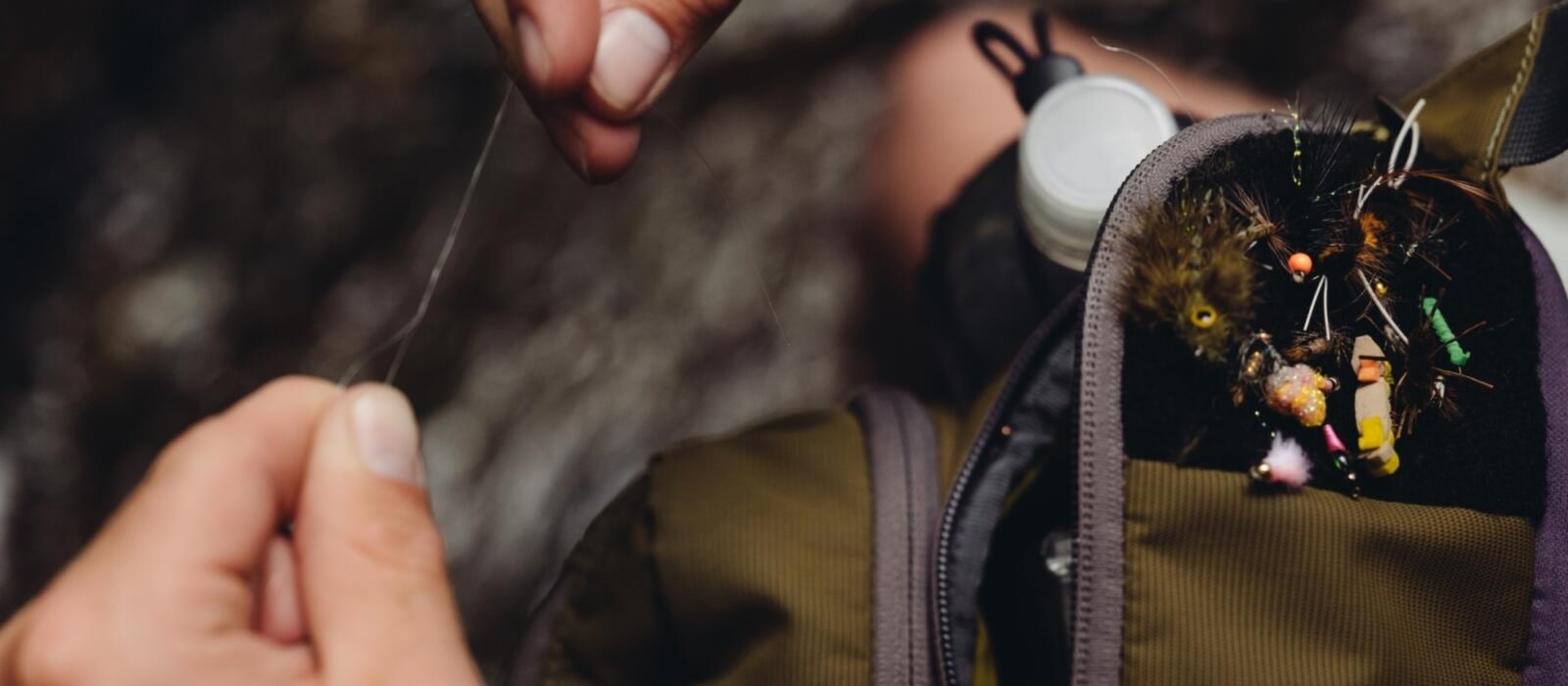
My time in fly fishing has given me far more than I ever deserved to receive out of it. It has led me to beautiful places, allowed me to explore breathtaking country, placed some of creation’s most spectacular flora and fauna at my fingertips, and introduced me to beautiful souls around the world whom I now call friends. It has even granted me the opportunity to pull off a small handful of feats which many would consider improbable. However, what I find intriguing is that when I flip through the pages in the mental novella of my fishing prowess, the chapters bear neither title nor tale of these.
Instead, chapter one reads “Salmo Sorrow.” It is a reference to the first and largest of any big brown trout I ever laid eyes on in the Great Smoky Mountains National Park while learning to target those mythical beasts. The story tells of the hard lessons I learned through my time with her, from the time she came unhooked from my line – teaching me how not to rig my flies – to the dozens of castless hours spent watching her from the bank, studying and developing a fledgling understanding of how she behaved. After three years of pursuing this fish, three years of regular visits, she disappeared. Time after time, I came to our regular meeting spot, searching high and low in the surrounding areas, but she was nowhere to be found. My fears had been realized as the day, which I always knew to be imminent, had come. It was apparent that the old gal had finally died before I was ever able to hold her in my hands – all because I yet lacked the knowledge to sufficiently predict her behaviors. She left me with a compulsive drive to understand all that I could about “big fish” – a drive that I heavily credit for my success in that arena in the time since she passed.
Chapter two reads “Esox Hamartia.” In this tale, after two years of futile pursuit paired with no shortage of late nights, long drives and frozen digits, I hook my desperately anticipated first musky on a fly rod. To say the fish then slid into the net uneventfully would provide a much-needed uplift to this narrative. Instead, he released himself from my hook mere inches from the boat and less than a second before my companion would have had the net in place to secure my catch. What was my fatal error? It was my hookset. Weak and initiated with a bent rod, that strip-set was bound for failure from the beginning. Once I arose from my adolescent tantrum on the floor of the boat, I vowed to relentlessly practice until I could divorce myself from excitement and strip-set as though my veins ran with ice. This is a skill I am now proud to say that I possess, even if it is mostly credited to me still being a bit numb from that loss.
The third chapter is titled “Sciaenops Zeal.” My journey with redfish began with a rocky start. First, I struggled to even find fish, then to catch them, then to catch a sizable specimen. With the help of one of those aforementioned beautiful soles named Sam, I was slowly overcoming these hurdles. On the night of this particular account, Sam put me on the biggest bull redfish I have ever laid eyes on. We spent many moments unsuccessfully delivering our best sales pitches to this fish, but eventually a fly change did the trick. The fish finally followed the fly wholeheartedly. I “fed” him, and he felt my School of Hard Knocks degree in strip-sets. Chaos ensued as the fish was thrashing and my heart pounding, but in my zeal to quickly boat him, I broke off the fish for an overabundance of pressure on the line. It was another lesson hard learned and another discipline of my craft to which I was compelled to devote myself.
There are many more like these chapters, but the common thread through all is that the peaks play little role. The stories are named for the valleys and tell of the ascents – the failures and the dedication to the craft. It is not simply that these cannot be untangled from the story, but rather that without them, there would be no story. I suppose this is what draws anglers to fly fishing in the first place. We are tired of winning, tired of things being too easy. Thus, we entrench ourselves in a craft in which we never cease to fall short. Because what worth is a peak without a valley, a victory without an opponent, a resolution less any antipathy or a craft which necessitates no such suffering? I declare ardently that the value of such things is null. Though I no longer stand in the valleys chronicled here, there will be many more to come, and if ever I have risen above, it is merely because I stand on a mountain of failures.