
Article
A Bit of Home
by Bonjwing Lee October 26, 2019
My parents – both Chinese immigrants – have kept separate rice cookers since they arrived in the United States 50 years ago. My dad, who was raised in extreme poverty, prefers the cheaper and drier long-grain rice that could withstand the summer heat and humidity of his youth on the streets of Shanghai. My mother came from an upper middle-class family that could afford the more expensive and stickier short-grain rice, which she cooks for herself. Stripes being hard to change on a tiger, they refuse to eat from each other’s pot.
With parents like that, you’d think I’d be more conscious about my own relationship with rice. And yet, having been raised on it, I was shockingly unaware of its indelible effect on me until fairly recently. A few years ago, on a long-haul flight to Asia amidst an intense period of travel, I was served a bowl of rice. It was an otherwise unremarkable experience, except its appearance there, somewhere high over the Pacific Ocean, stirred up an unexpectedly deep, emotional response. Uncapping the lid, a curl of steam and that familiar, sweet fragrance enveloped me with a cradle comfort that transported me home. After four decades of eating rice, that one, seemingly random encounter as a weary traveler awakened a longing that rice had etched within me.
The importance of rice is not uniquely Asian, of course. A comforting catchall for the gravy, sauces, and drippings of home cookery, it’s a treasured staple around the globe. It’s especially so in the American South, where rice has been a favored sponge for the soulful stews of the Lowcountry, like chicken bog and purloo, and the jambalayas and gumbos of Louisiana.
And perhaps that explains why my father, who, even after five decades of living in the United States and never acquiring a taste for American food, loves Southern cooking. He is a testament to just how similar we are, despite our differences. The more broadly I eat, the more I’ve realized that taste memory is not only personal, it can also be shared across cultures. That’s because what is familiar is often what is most accessible.
I recently took an informal survey among my Chinese friends: I wanted to know how many of them grew up eating eggs scrambled with tomatoes, served over rice. It’s a simple and homey,Chinese dish that my mother used to make, and I was curious just how common it was among other Chinese families.
The response was overwhelming and enthusiastic. It was a crowd favorite. Even non-Chinese Asian friends chimed in with their own cultural variations – scrambled eggs with ketchup and rice, for example, from a Filipino friend; or Indian egg curry (ande ki kari), a tomato stewed with hard-boiled eggs and often served with rice, from another.
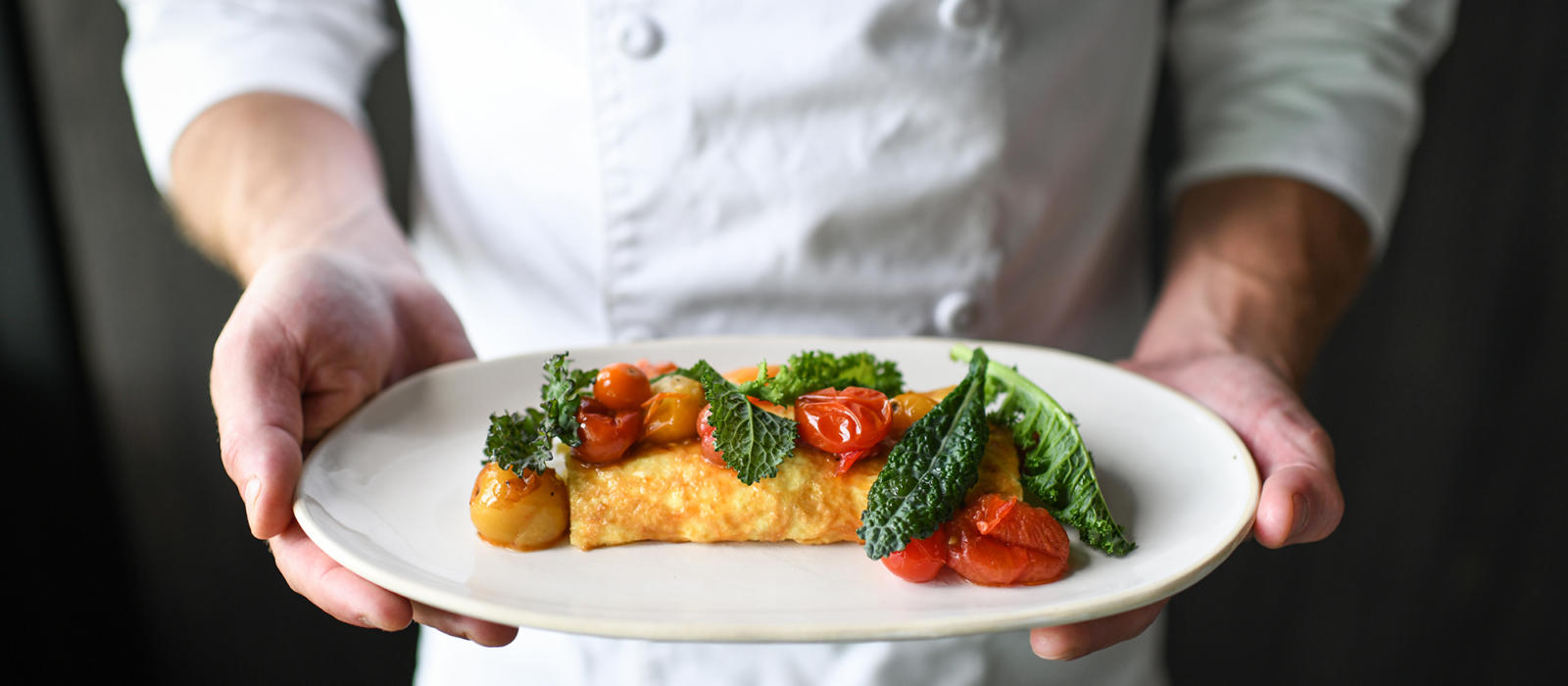
Even though eggs, tomatoes, and rice are common to the Southern pantry, you’ll rarely find them as a trio, the way you would in Asian cuisine. But I did, one morning at breakfast at the Firetower at Blackberry Mountain. There, Executive Chef Joel Werner scrambled eggs with cooked Carolina Gold rice to make an omelet. Because the rice is dry enough for the kernels to separate after cooking, but is incredibly tender, it almost disappears into the fluffy egg roll. The result is a creamier and more flavorful omelet, which Werner finishes with blistered tomatoes. When I asked him about it, he told me he thought the three would go together well.
And so they do.
Of course, the form and flavor are different from my mom’s home-cooked dish. But the comforting spirit was the same. And I especially loved it because, there, in an unlikely corner of the world, with the unfamiliar landscape of the Appalachia sprawling out before me, I found a bit of home.
Get the recipe for Chef Joel Werner's Carolina Gold Rice Omelet.