
Article
18 Karat
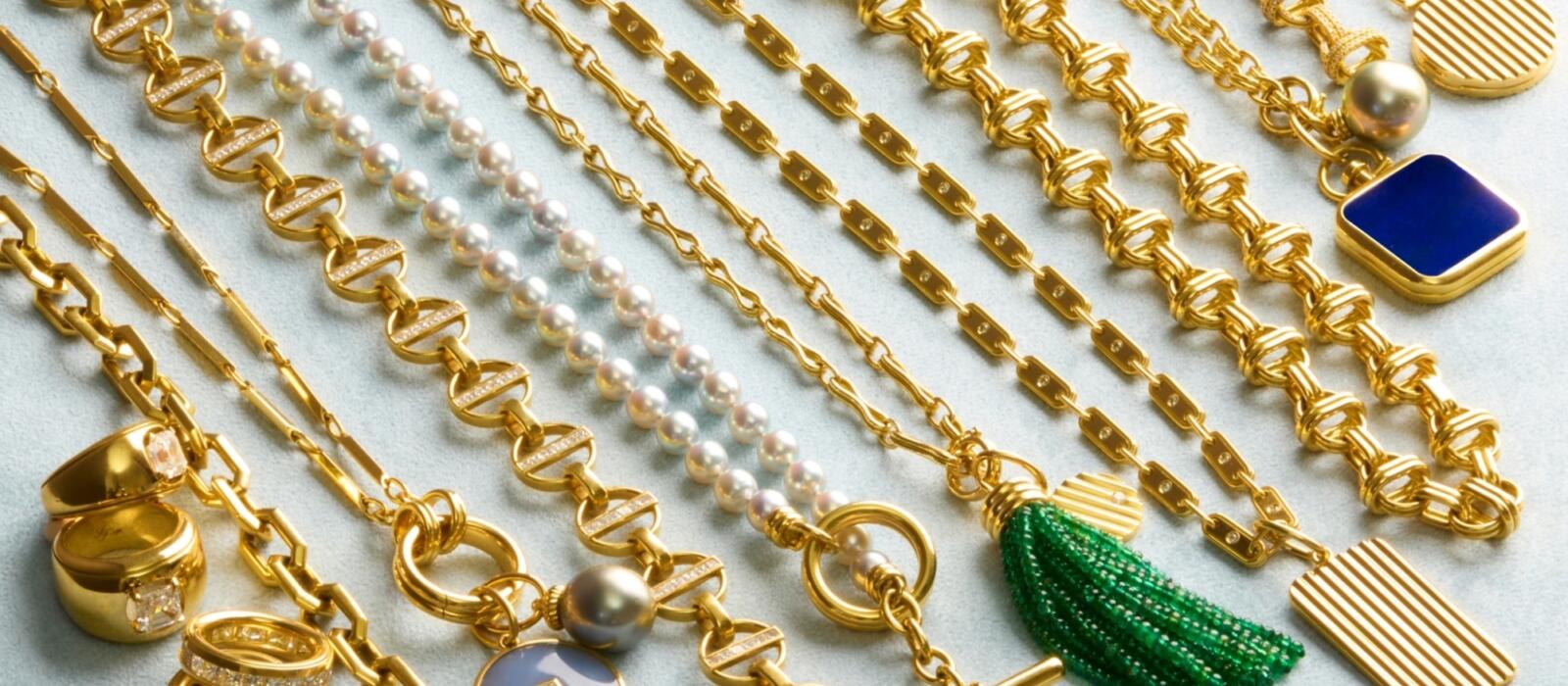
Mary Celeste: When we talked about creating The Golden Issue, I immediately thought of you! Beyond being a fan of your jewelry, you are known for your signature gold, which I love. Can you share a little about what makes your gold unique?
Danielle: Thank you – so fun to be a part of this issue! Our 18k yellow gold is our own proprietary color that we developed over the course of one year. Before I launched my first collection, I traveled to antique shows across the U.S. collecting 1940s retro and vintage jewelry, and I discovered that this period had the perfect 18k gold hue. It was warm but not too rose, and it added a richness to the piece. I sourced some of these pieces to match the same color, spending months perfecting the hue and making small adjustments to the percentages of alloys that comprise 18k yellow gold. All gold starts at 24k, and to arrive at 18k, you mix different percentages of other alloys to become certified 18k. Most of our clients come to us not just for our designs but also for the color of our gold.
MC: Now, take us back to the moment you first felt drawn to jewelry design. What sparked that path in your life?
D: My grandmother, Renee Sherman, always wore chunky gold jewelry. Whether she was spending the weekend at her country cottage in Bolney, London, or at work, she wore a solid, heavy gold lapis ring on her pinky, heavy gold bracelets and often one or two long gold chains layered together. I never had the opportunity to talk to her about her jewelry, but, like me, it seems as if she liked to mix textures and shapes, and none of the pieces she wore looked like a matching set. So when I think back to the initial spark, I immediately think of her.
MC: Life is full of change and transformation. I know you’ve had some really interesting milestones in your career, like co-founding The Row and working with Alexander Wang, but eventually your work in fashion evolved to founding Sherman Field. How has your journey, both professionally and personally, shaped your relationship with your craft today?
D: I’ve always been obsessed with craft and making things, even from a very young age – from taking sewing classes at Jo-Ann Fabrics at age 12, alongside mostly older women, to making necklaces for my friends out of vintage rosaries I found at flea markets. I’ve found the most joy and fulfillment in using my hands to make things, shape things and mold things into something special. During my fashion career, there came a point when I was using my hands less. I was still sketching, but I was not engaging with materials the way I had very early on. Upon founding Sherman Field, I returned to the art of sculpting clay, and rather than sketching my ideas, I found that sculpting best illustrates the scale, proportion and detail of our links. To this day, I still sculpt much of our jewelry, as I find that interacting with form in this way not only makes each piece more distinctive but also helps me develop ideas in a more thoughtful way.
MC: I love that the name for Sherman Field was inspired by the clothing brand your grandparents founded in the ’60s and that you found inspiration from jewelry styles of the past. How do you approach designing pieces that connect to history but work for modern day?
D: I have press clippings from my grandparents in old paperback albums spanning the 1950s through the late 1960s, from Vogue and Harper’s Bazaar, some of which were photographed by Helmut Newton. It’s always helpful to return to this archive to see how they designed, how the clothing was styled and how photographers captured that era. I also look through archival sketches from notable houses of the 1930s through the 1970s to explore interesting techniques, settings and the proportions and scale of jewelry from those periods.
MC: Gold is often used as a symbol of legacy and permanence. What does “gold” mean to you personally and creatively?
D: Gold means heritage, tradition, life and, of course, permanence. Anything and everything made in gold is a forever thing. For me, I’ve always viewed gold as something that honors the traditions of the past, present and future. I design jewelry to be passed down for generations to come. Jewelry should reflect the weight of those past traditions; it should be crafted, formed and sculpted into something that honors this idea of permanence. Nothing about it is light or whimsical. It has substance, and when formed into something beautiful, it takes on a new life.
MC: I have gifted some of your jewelry to my daughters. I love that they are beautiful and special pieces that can become heirlooms to pass down but also that they’re so wearable. How do you balance artistry with wearability, especially when designing pieces that people will carry with them daily?
D: When I design, I always ask myself whether this is something I would wear – how I can make something that is ultra-feminine, cool, wearable, stackable and modern. I love that my jewelry is often influenced by earlier periods; however, period pieces can be challenging to wear because they tend to feel dated and not entirely relatable. That said, if I love it and I’m excited by it, I trust intuitively that others will be too!
MC: In a world moving toward fast fashion, what does it mean to you to create something lasting and meaningful?
D: It means everything. I love vintage, and making jewelry that will itself one day be vintage is very important to me. Everything we produce is antithetical to fast fashion. I launch pieces when they are ready to launch. We never rush a piece or a collection. If a category needs more time to fully develop, we give it that time. Fine jewelry – true fine jewelry – cannot be rushed, as it is deeply process-oriented. You cannot skip a step or do something halfway. I love that. I love process, and I respect it immensely.
MC: Looking ahead, what kind of legacy do you hope your jewelry – and your story – will leave behind?
D: I hope it will serve as a kind of discovery for people – marking a time when so many brands chase trends – and stand as a brand that is, in a sense, an outlier. I hope people discover the story: the story of my grandparents, its origins and how I have worked to carry this brand and the same ethos it stood for into modern day.
MC: If someone wants to start investing in their jewelry collection, what piece from Sherman Field would you say they should start with?
D: I would start with our signature Oval Chain Necklace (which is two bracelets that connect to form a single necklace) or our Convertible Chain Necklaces, which you can wear multiple ways – with all of our pendants or medallions, and even as a holder for your eyeglasses or sunglasses. If you’re looking to gift something to commemorate an anniversary, birthday, job promotion or new baby, our lockets make the most sentimental and memorable gifts. You can choose your stone from our colorful stone tray, customize the engraving (dates, initials, a heart), and we assemble your photos for you as well. I love my own locket – whenever I travel, I always have my kids with me!